Billions Network is building a global “trust layer” for humans and AI, powered by privacy-preserving identity verification and a community-first token, $BILL. In a world where bots, deepfakes, and fake accounts flood every platform, Billions offers a simple promise: verify everything, reveal nothing. You can prove you’re real (or that your AI is legit) without handing over your entire life to some centralized database.
Launched in early 2025, Billions quickly attracted millions of verified users and serious backers, with over $30 million raised from top crypto and AI investors. Now the network is rolling out its token, $BILL, along with an airdrop, IDO, and long-term tokenomics designed to reward real contributors instead of mercenary hunters.
What Is Billions Network?
Billions Network is a decentralized identity and reputation protocol for both humans and AI agents. Instead of using biometrics or intrusive KYC, Billions relies on cryptography and zero-knowledge proofs (zkProofs) to confirm that:
- You’re a unique human (or AI agent), not a bot army.
- You’re verified in a compliant way without exposing all your documents everywhere.
- Your identity can be reused across multiple apps without constantly re-doing KYC.
Think of Billions as a reusable “verified passport” for Web3 and AI: verify once on your phone, then use that proof across DeFi, airdrops, dApps, games, and even AI agents that need trust and reputation.
$BILL Tokenomics: Supply, Distribution, and Utility
Fixed Supply and Deflationary Design
The $BILL token is an ERC-20 utility token deployed on an Ethereum Layer-2. It comes with a fixed total supply of 10 billion tokens and 0% inflation. No extra minting, no hidden emissions. Once all 10 billion are distributed, that’s it.
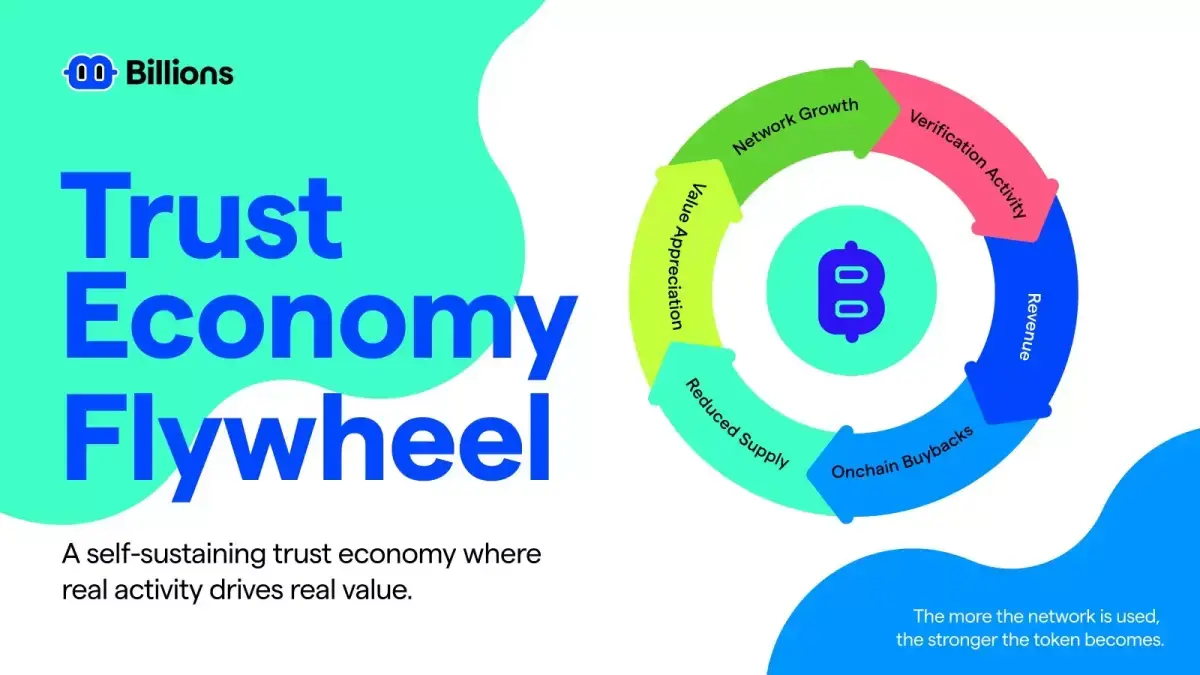
Instead of printing new tokens for rewards, Billions leans into a usage-based, deflationary model: fees generated by verification and credential issuance are used to buy $BILL on the open market and burn it. Over time, more network usage means:
- More fee revenue
- More $BILL buybacks
- More tokens burned and removed from supply
If adoption grows, that feedback loop can make $BILL progressively scarcer while usage ramps up.
Token Allocation Breakdown
Billions designed $BILL’s allocation to heavily favor the community and long-term stability:
- Community – 32%
The largest slice goes to the community via airdrops, rewards, staking incentives, hackathons, and growth programs. Only a small chunk unlocked at launch; the majority vests over time to power long-term adoption. - Contributors (Team & Builders) – 25%
Allocated to the core team and developers building in the ecosystem. Tokens have a 1-year cliff (nothing released in year 1), followed by 3 years of linear vesting across years 2–4. - Foundation Reserves – 18%
Used for operations, liquidity, and stabilizing the network. These tokens unlock gradually over 4 years to avoid a giant supply dump. - Investors – 15%
Strategic backers from the fundraising rounds. Their allocation is also locked for the first 12 months (cliff), then vests linearly over 4 years. - Ecosystem Fund – 10%
Set aside for partnerships, integrations, and strategic programs. About 5% of total supply (half of this bucket) unlocked at TGE to bootstrap liquidity and integrations, while the remaining 5% is held for future ecosystem expansion.
How $BILL Is Used in the Network
$BILL is not just a “logo token” — it’s deeply woven into how Billions works:
- Verification Fees & Access Discounts
dApps, protocols, and organizations pay fees to verify humans or AI agents and issue credentials. Paying those fees in $BILL gives a discount (around 10–15%), incentivizing heavy users and integrators to hold and spend $BILL. - Staking & Reputation
Users, nodes, and even AI agents can stake $BILL to signal trustworthiness and access higher reputation tiers. Stakers can earn a share of protocol revenues while unlocking upgraded features, better rewards, or higher trust scores. - Buyback-and-Burn Mechanism
A portion of protocol fees is used to automatically buy $BILL on the market and burn it, gradually shrinking circulating supply. - Governance (Future)
As Billions decentralizes, $BILL will be used for governance — voting on grants, parameters, attester sets, and other protocol decisions. - Ecosystem Incentives
From hackathon prizes and integration incentives to referral programs and node rewards, $BILL is the default reward currency inside the ecosystem.
Altogether, $BILL acts as the fuel of the Billions trust economy, tying token value directly to real usage and participation.
Token Generation Event (TGE) and Launch Details
Timing and Initial Circulating Supply
The $BILL Token Generation Event (TGE) landed in late 2025, following months of testnets, airdrop campaigns, and an IDO on the Kaito launchpad. At TGE, roughly 23% of the total 10 billion supply entered circulation — about 2.3 billion $BILL.
This initial float covered:
- Community rewards and airdrops becoming claimable
- The unlocked portion of the ecosystem fund (5% of total supply)
- Whatever tokens the foundation needed for market-making and liquidity
Team and investor allocations remained fully locked at TGE, so early circulating supply was community-heavy by design.
Community Airdrop and Public Sale
Billions went hard on being community-first:
- Points + Airdrop Campaign (2025)
Leading into TGE, users farmed points through tasks, app usage, referrals, and early participation on the network. A mid-September 2025 snapshot locked in who qualified for the airdrop. - Public Sale / IDO (Kaito Launchpad)
A public sale ran in early August 2025 on Kaito’s Capital Launchpad, with a structure where 75% of purchased tokens unlocked at TGE and 25% vested over 12 months. That design discouraged instant dumping and aligned buyers with the project’s long-term vision.
By late November 2025, airdropped tokens became claimable, meaning early supporters turned into actual token holders right as the network hit mainnet mode.
Exchange Listings and Liquidity
Around the launch window, Billions secured initial exchange listings so that:
- Early users could trade or accumulate more $BILL.
- The token had live price discovery and liquidity from day one.
- Ecosystem partners had easier access for integration and incentives.
Listings started on mid-tier exchanges with more platforms expected over time as liquidity and demand grow.
Vesting Schedule and Unlock Timeline
To avoid nasty unlock surprises, Billions spread token emissions across a four-year window. Here’s the high-level unlock timeline:
At TGE (Year 0)
- About 23% of total supply in circulation.
- Community, ecosystem, and initial liquidity allocations unlocked.
- Team and investors: 0% unlocked.
End of Year 1
- Cumulative circulation grows to around 45%.
- Most new supply this year comes from community rewards and ecosystem spending.
- Team and investor tokens are still under cliff, so early dilution mostly benefits users and builders.
End of Year 2
- Cumulative circulation reaches roughly 62%.
- Team and investor cliffs expire, and their tokens start vesting linearly.
- Community emissions slow down compared to Year 1 but continue to support growth.
End of Year 3
- Around 83% of total supply unlocked.
- Most major buckets (community, ecosystem, and a large portion of team/investor allocations) are now in circulation.
- The network is considerably more mature, with a broad, diversified holder base.
End of Year 4 and Beyond
- 100% of the 10 billion tokens are unlocked.
- No new supply enters from vesting — the only supply changes come from burns and secondary market movements.
- At this stage, Billions aims to be fully community-owned, with governance and value capture driven by actual network usage.
This long-tail vesting schedule is designed to prevent sudden supply shocks, protect early community members from brutal dilution, and keep builders and investors aligned with the protocol for several years.
Recent Developments and Ecosystem Growth (Late 2025)
Late 2025 has been all about moving from “promising protocol” to “live trust network”:
- Tokenomics Reveal – The team publicly laid out the full $BILL design: fixed 10B supply, zero inflation, community-first distribution, and a burn-powered deflationary model.
- Regulatory Transparency – Billions submitted its official token whitepaper to regulators in Spain, aligning with EU crypto asset rules and signaling a serious, compliant approach.
- Massive User Base – By late 2025, the network has grown to millions of verified users, showing real adoption beyond pure speculation.
- Partnerships – Billions has been integrating with Web3 projects, AI platforms, and even neo-bank style apps, providing zk-based KYC and “verify once, use everywhere” credentials.
- Marketing & Education – On social channels, Billions consistently leans into the “Verify everything, reveal nothing” narrative and positions itself as a non-biometric, privacy-first alternative to Worldcoin-style proof-of-personhood systems.
Net result: by the time $BILL launches, the network already has real users, live integrations, and strong narrative momentum around human + AI identity.
How to Join Billions Network and Farm the Airdrop
Want to get early exposure to $BILL and the Billions ecosystem? Here’s a simple flow to get started with the airdrop-style rewards and community programs.
Step 1: Sign Up with a Referral Link
Use this community link to join Billions and start stacking Power points:
? Join Billions Network via Airdropbuzz (Referral Link)
Create your account using your mobile device and follow the in-app steps. Billions is built mobile-first, so you’ll be guided to download the app and connect your account.
Step 2: Verify and Earn Points
Inside the app, you can typically earn Power points by:
- Completing your humanity verification (non-biometric, ID + phone-based).
- Inviting friends via your referral link.
- Completing in-app quests and social tasks.
- Engaging with ecosystem partners that integrate Billions verification.
These points later map into token rewards or allocation tiers when airdrops and loyalty rewards go live.
Step 3: Track Airdrop Phases and Claims
Billions runs its airdrop and rewards campaigns across multiple phases:
- Points farming phase – You complete tasks and accumulate Power.
- Snapshot phase – The team announces a snapshot date to lock in eligibility.
- Claim phase – Eligible users can return to the app or claim portal to receive their tokens.
Make sure you:
- Keep your account secure and linked to your wallet.
- Follow official Billions social channels for claim announcements and deadlines.
- Avoid third-party “claim” sites that might be phishing attempts.
Eligibility Basics
Exact criteria can change per campaign, but in general, you’ll want:
- A verified Billions account (human or AI agent).
- Some combination of Power points, referrals, and task completions.
- A compatible wallet connected to receive $BILL when claim windows open.
If you’re reading this while Billions is still in the rewards phase, you’re early enough to position for future rounds and ecosystem incentives.
Risks and Things to Watch
As bullish as the narrative is, there are still risks and trade-offs to keep in mind:
- Market Volatility – $BILL is a new token in a highly speculative market. Prices can move violently based on listings, unlocks, and broader crypto cycles.
- Unlock Events – Even with a careful vesting schedule, cliffs expiring (especially for team and investors in Year 2+) can introduce short-term sell pressure.
- Regulatory Landscape – Digital identity + tokens is a heavily watched space. Changes in regulation could affect how Billions onboards users or operates in certain jurisdictions.
- Execution Risk – The vision is big: a global trust network for humans and AI. That requires infrastructure, UX, partnerships, and community to all line up over multiple years.
- Data & Privacy Practices – Even with zero-knowledge tech, users should always review what data is collected, how it’s stored, and what’s on-chain vs off-chain.
None of this is financial advice — always size positions responsibly and do your own research before buying tokens or locking capital.
Join the Billions Trust Economy
? Join Billions Network with Airdropbuzz
Want first-row access to the Billions airdrop, $BILL token, and future ecosystem rewards? Join through our community link, lock in your spot, and start stacking points for being provably human.
✅ Join Billions with Airdropbuzz Referral
No biometrics. No creepy KYC warehouses. Just a mobile-first, zk-powered identity layer designed for humans and AI — with rewards for those who show up early.
FAQ
What is Billions Network?
Billions Network is a privacy-first identity and reputation protocol for humans and AI agents. It lets you prove that you’re real and unique without exposing your private data everywhere, using zero-knowledge proofs and decentralized credentials.
What is the $BILL token used for?
$BILL fuels the Billions ecosystem. It’s used to pay discounted verification fees, stake for reputation and rewards, fund ecosystem incentives, and — in the future — participate in protocol governance. It also has a built-in buyback-and-burn mechanism that can reduce supply over time as usage grows.
How does the Billions Network airdrop work?
The airdrop revolves around Power points earned by verifying, referring friends, and engaging with the app and ecosystem. At snapshot dates, Billions calculates each user’s share and later opens a claim window where eligible users can redeem $BILL. Exact rules can vary per phase, so always follow official announcements.
Is my identity data safe with Billions?
Billions is designed with privacy as a core feature, using zero-knowledge proofs and non-biometric verification. You prove that you meet certain criteria (human, unique, compliant) without broadcasting your entire identity on-chain. Still, you should always review the latest documentation and privacy policy and only use official apps and links.
When will all $BILL tokens be fully unlocked?
All $BILL tokens are scheduled to be fully unlocked by four years after TGE. The rollout starts with about 23% in circulation at launch and gradually increases as community, ecosystem, team, and investor allocations vest over time.
Is investing in $BILL a good idea?
That depends on your risk tolerance and thesis. $BILL sits at the intersection of identity, AI, and Web3 — a strong narrative but also a competitive field with regulatory attention. Treat it like any high-risk crypto asset: do your own research, track unlock schedules and partnerships, and never overexpose your portfolio.
How do I get started with Billions using the Airdropbuzz link?
Click the referral link in this article, sign up on Billions, complete your verification, and start farming Power points through tasks and referrals. That positions you for current and future airdrop-style rewards if you meet the eligibility criteria at snapshot times.