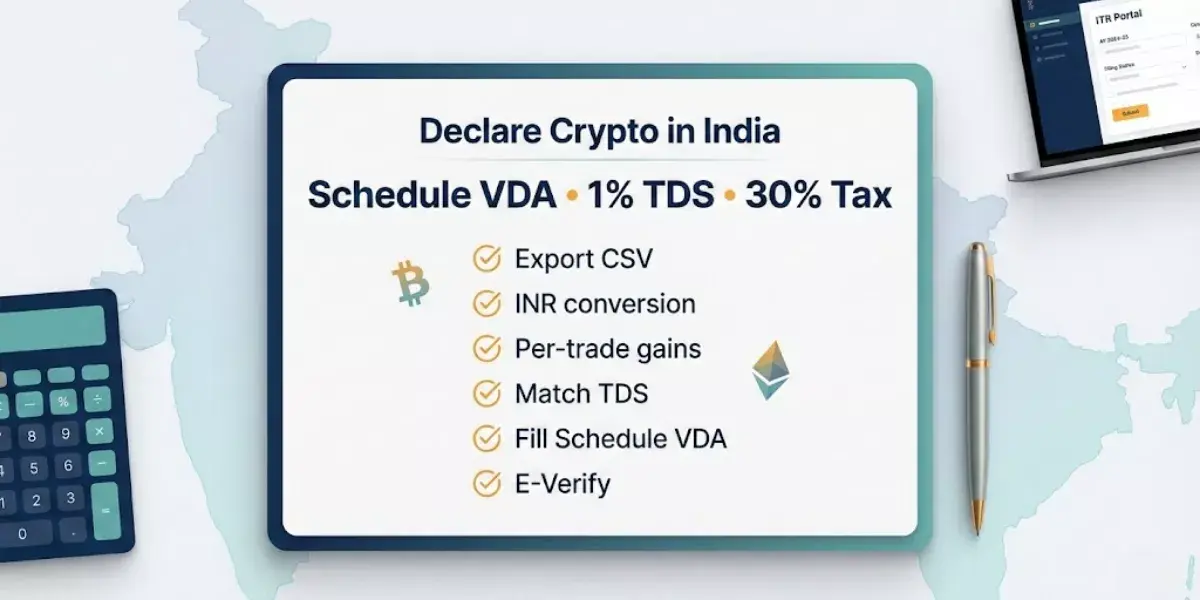
Want to avoid ITR mismatches and “please explain this trade” emails later? Do this: download your complete crypto history, calculate gains per transfer, match your 1% TDS, and fill Schedule VDA transaction-wise. This guide keeps it beginner-friendly—no tax jargon overload—so you can confidently declare crypto in your ITR (and claim any TDS credit you’re owed).
| Time Required | Cost | Risk Level | Our Verdict |
|---|---|---|---|
| 30–90 mins (per year, per PAN) | Low (mostly record-keeping) | Medium if you skip trades / TDS mismatch | Worth doing: filing correctly is faster than fixing notices later. |
New to crypto? Here are common exchanges people use (placeholders): Pick one where you can easily export transaction history (CSV) for tax time. These are not recommendations—always DYOR and check fees, KYC, and risk.
- Binance — Open Binance
- Delta — Open Delta Exchange
- ZebPay — Open ZebPay
- Bitget — Open Bitget
Pro tip: wherever you trade, export Spot trades, Convert/Swap, Deposits/Withdrawals, and Earn/Staking logs (if any). Missing one usually creates “why doesn’t this match?” problems later.
What is declaring crypto in India?
Declaring crypto in India is the process of reporting your taxable “Virtual Digital Asset” (VDA) activity—like selling, swapping, or otherwise transferring crypto/NFTs—inside your Income Tax Return (ITR), typically using Schedule VDA. In practice, it means you compute your gain per transfer (sale value minus cost of acquisition), report each transfer transaction-wise, and reconcile any 1% TDS that may have been deducted on your trades. This guide focuses on the most common individual scenario: crypto treated as investment/capital gains (ITR-2) or, if it looks like active trading/business activity, potentially ITR-3 (best confirmed with a CA). The rules come from India’s Income Tax framework—there’s no “project team” here—so accuracy and records matter more than fancy tax tricks.
Our Experience Joining Declaring Crypto in India
The AirdropBuzz Team reviewed the latest ITR flow and the Schedule VDA layout. The biggest friction point isn’t the portal—it’s your data. If your trades are spread across multiple exchanges, plus a couple of wallets, you’ll need to consolidate before you start. Schedule VDA expects each “transfer” as a transaction, and it’s easiest when you already have a clean spreadsheet: date acquired, date sold/swapped, cost, consideration (in INR), and TDS (if any).
Time vs Reward: Is “doing it properly” worth it?
Yes—because crypto tax in India is record-driven. The “reward” here is not getting stuck in a mismatch loop: you claim the right TDS credit, you reduce the chance of notices due to missing trades, and you avoid last-minute panic. Realistically, if you have:
- 0–20 transfers: 30–45 minutes
- 20–200 transfers: 60–120 minutes (you’ll want a spreadsheet)
- 200+ transfers: use a crypto tax tracker or a CA—manual entry gets painful
Also important: if you had TDS deducted (1% on applicable trades), filing correctly is how you claim that credit against your final tax bill (or get a refund if you overpaid via TDS).
Risks & Things to Watch
- Thinking “only INR sales are taxable”: crypto-to-crypto swaps are typically treated as transfers too—don’t skip them.
- TDS mismatch: your exchange may have deducted 1% TDS, but your return doesn’t reflect it (or vice versa). Always reconcile using your tax statements.
- Loss confusion: many people try to net off crypto losses against other income. VDA losses are treated differently—be careful how you compute and report.
- Multiple exchanges + wallet transfers: wallet-to-wallet transfers aren’t “sales,” but they can look like disposals if your history is incomplete. Keep a simple “transfer log.”
- Overseas exchanges: if you use non-Indian platforms, TDS may not be deducted, but tax can still be payable. Keep strong INR valuation records for each transfer.
- Gifts/airdrops/rewards: “free crypto” can be taxable on receipt under certain rules, and then taxed again when sold. If you received crypto for free, consider professional advice.
Step-by-Step Guide: How to Declare Crypto in India
- Collect your full year transaction history
- Download CSVs from every exchange you used (Spot/Convert/Swap/Futures if any).
- Export “Earn/Staking/Rewards” history if you used them.
- Note all wallets you moved funds through (even simple transfers).
- Separate “transfers” from “non-taxable movements”
- Transfers (usually taxable): sell for INR/fiat, swap crypto-to-crypto, spend crypto, convert into another token.
- Movements (usually not a sale): withdraw from Exchange A to your wallet, then deposit to Exchange B.
- Convert every taxable transfer into INR
- For INR pairs: use the trade value in INR.
- For USDT pairs or non-INR pairs: use an INR conversion rate on the date/time of transfer and keep the basis consistent.
- Save proof (exchange export, rate snapshot, or calculation notes).
- Compute gain per transfer (simple formula)
Gain = Consideration received (INR) − Cost of acquisition (INR)
- Keep it transaction-wise (one row per transfer).
- Trading fees exist in real life, but treatment can be tricky—don’t assume everything is deductible unless you’ve confirmed your method with a CA.
Mini example: Buy ₹1,00,000 BTC → later sell for ₹1,40,000 → gain ₹40,000 → tax is computed on this gain (plus surcharge/cess as applicable).
- Track 1% TDS (if applicable) and reconcile it
- Check your exchange “TDS” reports/ledgers (many provide a tax statement).
- If TDS was deducted, you usually want that credit reflected in your ITR so it reduces your payable tax (or increases refund).
- If you did P2P or trades where TDS wasn’t deducted, you may still owe the tax—don’t assume “no TDS = no tax.”
- Pick the right ITR form (common individual cases)
- ITR-2: common if you’re declaring under capital gains and you don’t have business income.
- ITR-3: possible if crypto activity is treated as business/trading income (high frequency, systematic activity, etc.).
- If you’re unsure, ask a CA—choosing the wrong form can create filing issues.
- Fill Schedule VDA carefully (transaction-wise)
- Enter: Date of acquisition, Date of transfer, Cost of acquisition, Consideration received, and the income from transfer (gain figure).
- If a transfer is at a loss, many people still list it for completeness, but the “income” field may effectively be treated as nil depending on the ITR design for that year.
- Double-check that your totals match your spreadsheet.
- Report non-trading crypto income (if you had it)
- Examples: staking rewards, referral rewards, airdrops, “earn” interest, gifts from non-relatives (depending on conditions).
- These can fall under different heads (often “Income from Other Sources”), and later selling the received crypto can create a separate “transfer” event.
- If you had any of this, it’s worth getting CA guidance to avoid double-counting or under-reporting.
- Review, pay any remaining tax, and e-verify
- Confirm totals, confirm TDS credits, and then submit.
- Always e-verify after filing—an unverified return can be treated as not filed.
- Keep your exports + calculations saved for future queries.
Quick “Don’t Mess This Up” Checklist

- ✅ Included crypto-to-crypto swaps (not just INR sells)
- ✅ Consolidated all exchanges + wallets (no missing CSVs)
- ✅ INR conversion method is consistent and saved
- ✅ TDS (1%) matched with your records
- ✅ Schedule VDA filled transaction-wise and totals match
Ready to get organized? Start by grabbing your transaction exports from the exchange(s) you used—this is the fastest way to make Schedule VDA painless.
Join “Declare Crypto in India” Now
Referral Disclosure: We may earn points if you use our link.
FAQ: Declaring Crypto in India
Is declaring crypto in India mandatory?
If you had taxable crypto activity (like selling or swapping) or you need to claim TDS credit, you generally should report it in your ITR. If you had no transfers and no crypto income, you may not have anything to report under Schedule VDA—but keep records anyway.
What is Schedule VDA?
Schedule VDA is a dedicated section in certain ITR forms where you report VDA (crypto/NFT) transfers transaction-wise—date of acquisition, date of transfer, cost, consideration, and the resulting income/gain.
Do I pay tax if I only swapped crypto-to-crypto (no INR withdrawal)?
In most practical tax interpretations, a swap is still a “transfer,” so it can trigger a taxable gain even without INR hitting your bank. Always maintain INR values for the swap date.
What is the 1% TDS on crypto, and can I get it back?
On eligible transfers, TDS may be deducted at 1%. In many cases it’s a credit—meaning it reduces your final tax payable, and if it’s more than what you owe, it can contribute to a refund when you file correctly.
Is crypto tax “confirmed” at 30% in India?
Income from transfer of VDAs is taxed at a special rate under current rules, and Schedule VDA exists for reporting it. However, tax treatment can vary by facts (trading vs investing, gifts, rewards), so consult a CA for your specific situation.