You want the “100% win” formula? Here’s the truth: no prediction market strategy guarantees 100% wins because reality changes, liquidity shifts, and rules can bite. But you can follow a checklist that gives you 100% control over avoidable losses—the dumb mistakes that nuke beginners. The AirdropBuzz Team uses this exact system to trade like probabilities, not gamblers.
| Time Required | Cost | Risk Level | Our Verdict |
|---|---|---|---|
| 10–20 min/day | $5–$50 to start | Medium (rules + liquidity) | Worth it if you follow the checklist and treat prices as probabilities. |
| UX Score (/10) | Earning Potential | Reward Certainty |
|---|---|---|
| 8/10 (platform-dependent) | Med–High | Speculative |
Highlight #1: “100% win” isn’t a promise—it's a discipline standard. Your goal is to eliminate avoidable losses so your edge (even small) actually compounds.
What is a Crypto Prediction Market?
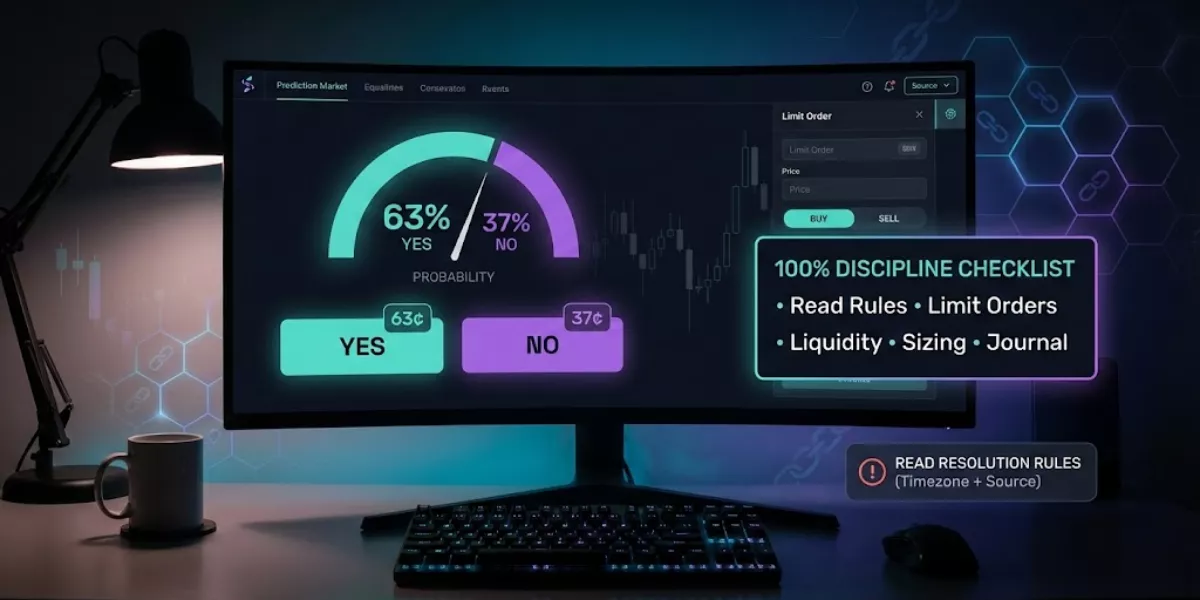
A crypto prediction market is an onchain marketplace where you trade outcome shares that settle to $1 or $0 based on a clearly defined event result. If “YES” trades at 63¢, the market is roughly pricing ~63% implied probability (plus spreads/fees). You’re not “betting”—you’re buying or selling probability when you think it’s mispriced, then holding (or exiting) based on rules + risk management.
The “100% Win” Checklist (The Non-Negotiables)
These rules don’t guarantee profits—but they do prevent the most common, completely avoidable losses.
- Rule #1: Read the resolution rules BEFORE you buy. Source, timezone, cutoff time, and exact wording matter more than your opinion.
- Rule #2: Limit orders only. Market orders are how you get farmed by thin liquidity.
- Rule #3: Trade liquid markets. If spreads are ugly or the order book looks dead, you’re paying “tax” to enter and exit.
- Rule #4: Define your invalidation. Write what news/event proves you wrong. If it happens, exit—no ego.
- Rule #5: Size like a pro. Start tiny. Scale only after 20+ journaled trades and stable execution.
- Rule #6: Avoid vague markets. If the question can be “interpreted,” it can be “resolved” against you.
- Rule #7: Never chase. If price moved without you, let it go. There’s always another market.
Highlight #2: If you follow Rule #1 + Rule #2, you already dodge most beginner losses.
Our Experience Joining Onchain Prediction Markets
When The AirdropBuzz Team tests a platform, we run a quick friction check:
- Wallet prompts: Are approvals reasonable, or does it ask for weird permissions?
- Funding path: Can we deposit/bridge smoothly without “surprise” steps?
- Order controls: Are limit orders easy, visible, and editable?
- Rules clarity: Is the resolution source explicit and easy to verify?
Most losses we see aren’t from “bad predictions.” They’re from bad process: skipping rules, using market orders, and oversizing.
Three Example Playbooks (Engaging, Not Gambling)
Playbook A: “The Calendar Edge” (Deadlines + Deliverables)
Markets tied to ship dates, unlock schedules, governance deadlines, or event windows can be tradable if the rules are strict. Your advantage comes from tracking official announcements and objective signals (audits, repositories, governance voting mechanics). If the market is vague, skip it.
Playbook B: “The Rule Trap Hunter” (Win by reading what others skip)
Sometimes the market isn’t mispriced on probability—it’s mispriced because traders didn’t read the fine print (timezone cutoffs, specific oracle sources, “as of” definitions). You don’t need to be a genius. You need to be the person who reads.
Playbook C: “Low-Drama Learning Loop” (Small size + short duration)
Pick short-duration markets so your capital frees up fast. Trade tiny. Journal every entry. The goal is building flawless execution. If you can’t explain why you entered in one sentence, you’re not ready.
Time vs Reward: What’s Realistic?
If you treat prediction markets like a system, they can become a repeatable side activity. If you treat them like “quick flips,” you’ll donate fees and slippage. Our recommendation: start with process goals (rules, limit orders, journaling) before profit goals. Profits come as a side effect of clean execution.
Risks & Things to Watch
- Resolution disputes: Outcomes can be delayed or challenged depending on platform rules.
- Liquidity risk: Thin books = bad fills and hard exits.
- Approval risk: Avoid unlimited approvals on unknown contracts; revoke periodically.
- Emotional trading: Tilt is the silent killer—especially after a “should’ve won” loss.
Step-by-Step Guide: How to Start (Without Getting Rektd)
- Choose one category you understand (crypto catalysts, governance, sports, etc.).
- Create a burner wallet dedicated to testing.
- Deposit a tiny amount (learning money, not rent money).
- Open one market and read the rules like a lawyer.
- Place a limit order only—never market buy into thin liquidity.
- Write your invalidation (what makes you wrong) before entry.
- Journal the outcome (why it won/lost, what you missed).
- Repeat 20 times before scaling size.
Highlight #3: The closest thing to a “100% win” is a “100% rules + discipline” habit. That’s how you stop bleeding and start compounding.
Where to Join Prediction Markets (Curated)
If you want live options to explore, start here:
https://airdropbuzz.com/category/onchain-prediction
Want to explore onchain prediction markets now?
Referral Disclosure: We may earn points if you use our link.
FAQ: Prediction Markets (Crypto)
Can you really get a “100% win rate”?
No—nobody can guarantee 100% wins because outcomes, liquidity, and resolution mechanics can change. But you can follow a checklist that removes most avoidable losses (rules, limit orders, sizing, and journaling).
What’s the #1 rule before entering a trade?
Read the market’s resolution rules (source, timezone, cutoff time, and wording). Many “unlucky” losses are actually rule misunderstandings.
Should beginners use market orders?
No. Use limit orders only. Market orders often fill at worse prices—especially in low-liquidity markets.
Is it expensive to start?
You can start small, but expect minor costs like spreads, platform fees, and possibly gas/bridging depending on the chain and platform.
What’s the safest way to learn?
Trade tiny size on clear, liquid markets, and journal 20 trades. Your first goal is consistent execution—profits come later.