How AirdropBuzz Automates Market Signals with Binance APIs
A technical walkthrough of how AirdropBuzz turns Binance market data into validated Market Pulse signals and publishes them through Square OpenAPI.

Binance API signal automation at AirdropBuzz begins with market evidence, not promotional copy. Market Pulse collects public Binance data, applies a fixed ruleset, validates the resulting setup and only then sends the completed analysis to Binance Square.
This distinction is central to the architecture: Binance supplies market data and publishing infrastructure, while AirdropBuzz creates the analysis. Square OpenAPI does not generate or approve a signal. By the time it receives an article or post, the bias, confirmation levels, risk plan and confidence classification already exist.
Two Binance interfaces, two different jobs
The system uses Binance market-data interfaces to collect price and derivatives evidence, then uses Binance Square OpenAPI as a distribution layer. The first side answers “what is the market doing?” The second answers “how do we publish the finished explanation consistently?”
Binance documents REST and WebSocket interfaces across its products, while its Spot REST documentation also identifies public market-data endpoints intended for data-only applications. The Square publishing workflow separately supports text posts, image posts and long-form articles.
Step 1: Collect the market evidence
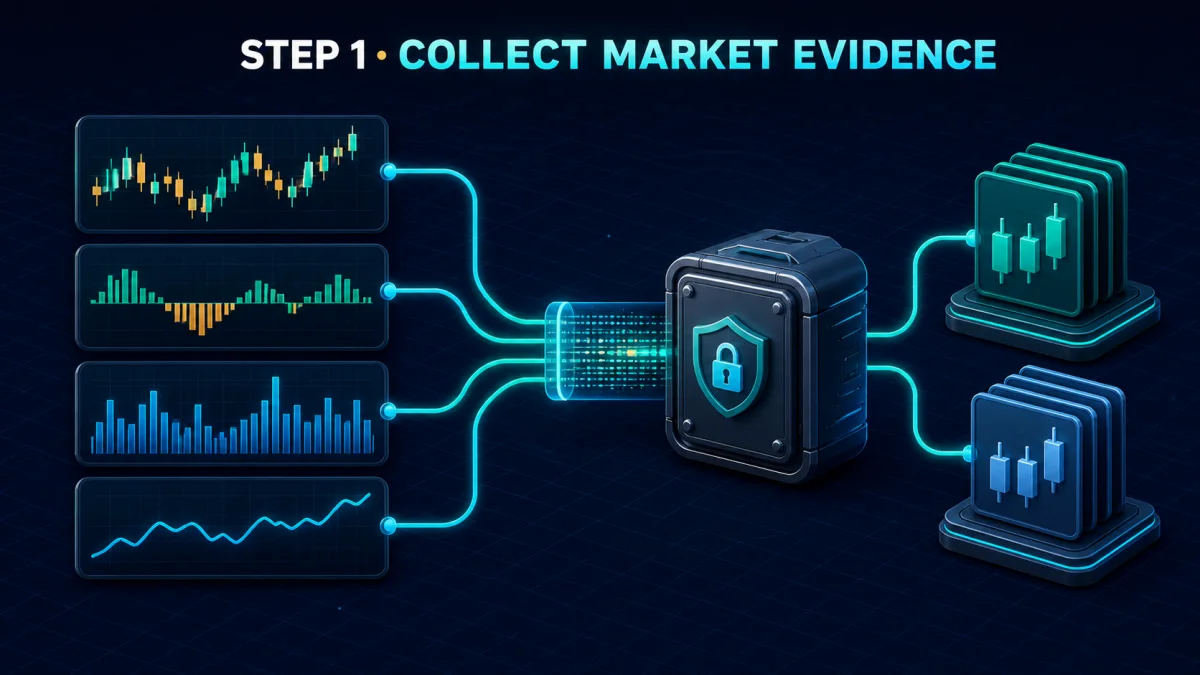
Each run collects the current spot price, 24-hour change, quote volume, recent signal candles, closed 4H and 1D candles, recent structural highs and lows, Average True Range and USD-M futures open-interest observations.
Closed candles are deliberate. A wick above resistance can disappear before the interval ends, so using an unfinished candle as confirmation would create avoidable false positives. Time-series data is normalized before any direction or confidence label is produced.
Step 2: Apply fixed signal rules
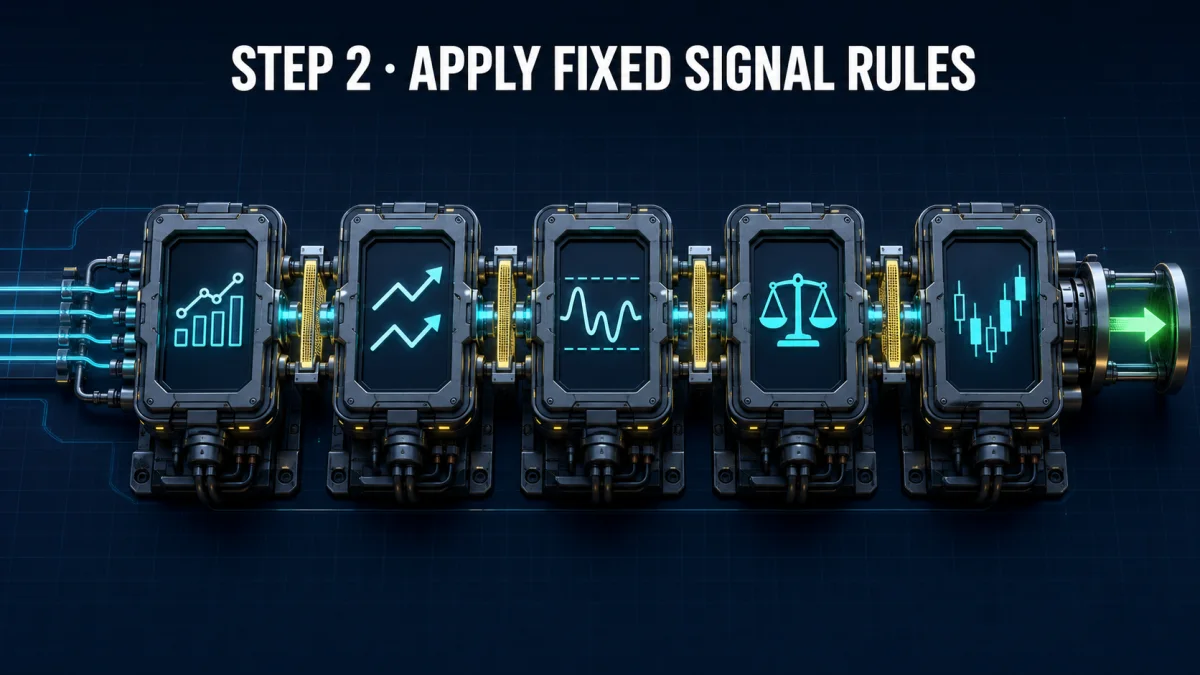
Open-interest confirmation
The engine compares the latest USD-M futures open interest with recent observations. Rising open interest can support a move because participation is expanding. Flat, falling or unavailable open interest prevents the highest confidence classification. It remains one input, not a standalone buy or sell signal.
4H and 1D trend alignment
Closed four-hour and daily structures are compared directly. Bullish plus bullish is aligned, bearish plus bearish is aligned, and opposing readings are a conflict. A directional setup that fights the daily structure is automatically treated with lower conviction.
ATR confirmation buffer
Support and resistance are treated as zones rather than perfectly precise lines. Market Pulse calculates ATR(14) and places its confirmation trigger beyond structure with a configurable volatility buffer. This reduces the chance that a minor wick or routine market noise is labelled a breakout.
Risk-to-reward validation
For each directional scenario, the engine calculates a confirmation entry, hard stop, nearest structural liquidity target, risk and potential reward. If the available reward does not justify the risk, the result is marked poor-profile or no-trade. A possible direction is not automatically an acceptable trade.
Closed-candle trigger
The bull or bear scenario only becomes eligible after the required candle closes beyond its buffered level. The trigger confirms a scenario; it is not itself a price target.
Step 3: Create one source of truth

After validation, the system creates one structured signal record containing the asset, timestamp, unified bias, confidence, confirmation levels, trend readings, ATR, open-interest condition, risk plan and supporting reasons.
The website, Square copy and visual all read from that canonical record. Calculating the assessment once prevents separate rendering paths from producing contradictions such as a bullish badge beside a neutral title or an alignment label that disagrees with its displayed timeframes.
Step 4: Generate the visual

The image pipeline renders a dedicated Market Pulse card containing the actual setup’s most important fields. Price formatting scales with the asset: higher-priced tokens avoid meaningless decimals, while sub-$1 tokens retain the precision needed to represent their market increment.
Binance Square receives a lossless upload suitable for its media-processing flow. The website receives a separately encoded WebP asset to keep the page lightweight without changing the displayed analysis.
Step 5: Publish and verify through Square OpenAPI

The publishing sequence requests a media-upload destination, transfers the cover, polls until processing completes, retrieves the processed image URL and then submits the long-form article. Article mode sends one title, one body and one cover; concise Market Pulse posts use the image-post format.
The Square OpenAPI key remains in the server environment. It is never included in page content, command-line arguments or public logs. Delivery records capture the result so failures can be diagnosed without blindly creating duplicates.
Scheduling without creating spam
Market Pulse currently runs on a controlled two-hour schedule and rotates through a defined list of liquid assets. State tracks the previous token, recent editorial hook styles, content hashes, the last successful publication and each channel’s delivery status.
Duplicate and similarity checks run before publishing. If a candidate is too close to recent content, it is rejected instead of being sent as another near-identical update.
What the automation does not do
- It does not place orders or manage positions.
- It does not access user balances.
- It does not guarantee a future price.
- It does not force every breakout into an actionable setup.
- It does not hide weak, conflicting or untracked outcomes.
Market Pulse produces structured, time-stamped analysis based on confirmation and risk rules. Historical outcomes are saved so follow-through claims can be checked instead of merely asserted.
Why Binance Square API matters
Without Square OpenAPI, the analysis could still be calculated, but publication would require someone to copy values, upload media and rebuild tags manually. API publishing reduces delay and removes several opportunities for transcription errors.
The objective is not to publish the largest possible number of predictions. It is to create timely, consistent and independently checkable market observations with stable rules and a visible track record.
Technical references: Binance Developer Documentation, Binance Spot REST API and Binance Square publishing workflow.
Educational only, not financial advice. Confirmation triggers are not price targets.
Reader discussion
Add useful context, questions or a different reading of the data.
Have something useful to add?
Sign in to comment. Requiring an AirdropBuzz account helps keep spam and wallet scams out of the discussion.
Sign in to comment
No comments yet. Be the first reader to add useful context.