Pi Airdrop Guide: Mining, Rewards, Risks, and KYC
Eligibility checklist, task flow, and safe-link verification for this campaign.
Get more AirdropBuzz stories on Google
Add AirdropBuzz as a preferred source so Google can highlight more of our airdrop guides, safety updates, and market research for you.
Use this with the risk signals below before connecting a wallet.
Airdrop research snapshot
Quick details before you spend time or funds
Pi Airdrop Guide: Mining, Rewards, Risks, and KYC Web3 Pi is not a normal “click once and claim” airdrop.
Verify supported chain and wallet before any task.
9 tracked steps in this guide.
Requires stronger risk control and task tracking.
Capital, fees, slippage, and liquidation risk may apply.
Pi Airdrop Guide: Mining, Rewards, Risks, and KYC Web3 Pi is not a normal “click once and claim” airdrop.
Open the official page from the safe link, then cross-check it with project docs and social channels before connecting a wallet.
Set a small budget first and count gas, bridge, slippage, deposit, and liquidation risk as part of the real farming cost.
Use referrals responsibly; focus on real participation because spammy activity can reduce eligibility quality.
Because this guide is not fresh, recheck the project announcement feed before spending funds.
Airdrop facts
- Status
- Active watch
- Chain
- Ethereum
- Sign-up cost
- Free
- Farming cost
- Deposit + trading fees + liquidation risk
- Gas
- Not the main cost
- Risk Level
- Medium
- Last Verified
- Aug 19, 2026
- Published Date
- May 11, 2026
- Official Links Reviewed
- Yes
- Editor Name
- Dhiraj Dixit
Pi is not a normal “click once and claim” airdrop. It is a long-running mobile mining project where users earn PI over time, pass KYC, and migrate rewards to Mainnet. The recent distribution news is real: second migrations and KYC validator reward payouts started in 2026. Our take? Pi looks more solid than most free mining apps, but it still has real risks around price, unlocks, migration delays, and user expectations.
This airdrop guide was reviewed by the AirdropBuzz research team, who have completed dozens of Solana and DeFi airdrops.

I'm Dhiraj Dixit, Application Engineer and founder of AirdropBuzz, focused on crypto airdrop research, AI/ML-informed product thinking, project verification, risk-first scoring, and practical Web3 guides.
Airdrop quick facts
What does this score mean? See the scoring methodology.

Step-by-Step Carousel
Swipe through steps quickly: Step 1, Step 2, Step 3 and more.
| Question | AirdropBuzz Verdict |
|---|---|
| Does Pi look solid? | The user base is massive and Open Network is live, but ecosystem liquidity and massive supply overhang present severe price risks. |
| Is the Pi airdrop confirmed? | This is not a traditional retroactive airdrop. Users mine $PI off-chain, complete KYC, and migrate balances to Mainnet over time. |
| Can mobile users still mine? | Yes, but the protocol utilizes an aggressively declining base rate model. Early adopters hold a massive advantage. |
| Is node mining worth trying? | Only for dedicated ecosystem participants with stable hardware. Node rewards are opaque compared to standard PoW or PoS protocols. |
| Main risk | Massive token dilution (100B max supply), delayed migration queues, and an insular ecosystem struggling to attract external liquidity. |
| Test Area | Score | Team Notes |
|---|---|---|
| Project maturity | 8/10 | Open Network is functional, and the project boasts one of the largest identity-verified user bases in crypto. |
| Reward clarity | 5/10 | Tokenomics exist on paper, but user-level migration pacing, node payouts, and true circulating supply are highly opaque. |
| Mobile mining UX | 9/10 | Frictionless daily flow. Requires zero technical expertise or crypto knowledge. |
| Cost Control | 10/10 | 100% free to mine on mobile. No gas fees or capital deposits required to participate. |
| Overall Score | 6.5/10 | A zero-risk, high-patience farm. Highly accessible, but heavily penalized by massive token dilution and extreme delays in realizing liquid value. |
What is Pi Network?
Pi Network is a mobile-first Layer-1 blockchain utilizing the Stellar Consensus Protocol (SCP) to allow users to mine cryptocurrency via their smartphones without draining battery life or relying on energy-intensive Proof-of-Work hardware. Founded by Dr. Nicolas Kokkalis and Dr. Chengdiao Fan, the project transitioned into its Open Network Mainnet phase on February 20, 2025, removing the firewall that previously isolated the ecosystem.
With an officially reported user base exceeding 70 million "Pioneers," Pi represents one of the largest mass-adoption experiments in the industry. However, unlike traditional DeFi protocols that bootstrap via capital deposits, Pi bootstrapped via human attention and identity verification.
Is the Pi airdrop confirmed?
Pi Network does not operate a traditional retroactive airdrop model. You cannot simply connect an Ethereum wallet, sign a message, and claim tokens. Instead, users accrue off-chain $PI via the mobile app, establish an internal trust graph ("Security Circle"), complete a rigorous KYC process, and systematically migrate their balances to the Mainnet blockchain.
Because the ecosystem relies on closed-loop app claims, users must be hyper-vigilant against phishing. $PI can only be migrated and accessed through the native Pi Browser and Pi Wallet. Any external website offering a "Pi Claim" or requesting your 24-word passphrase is a scam.
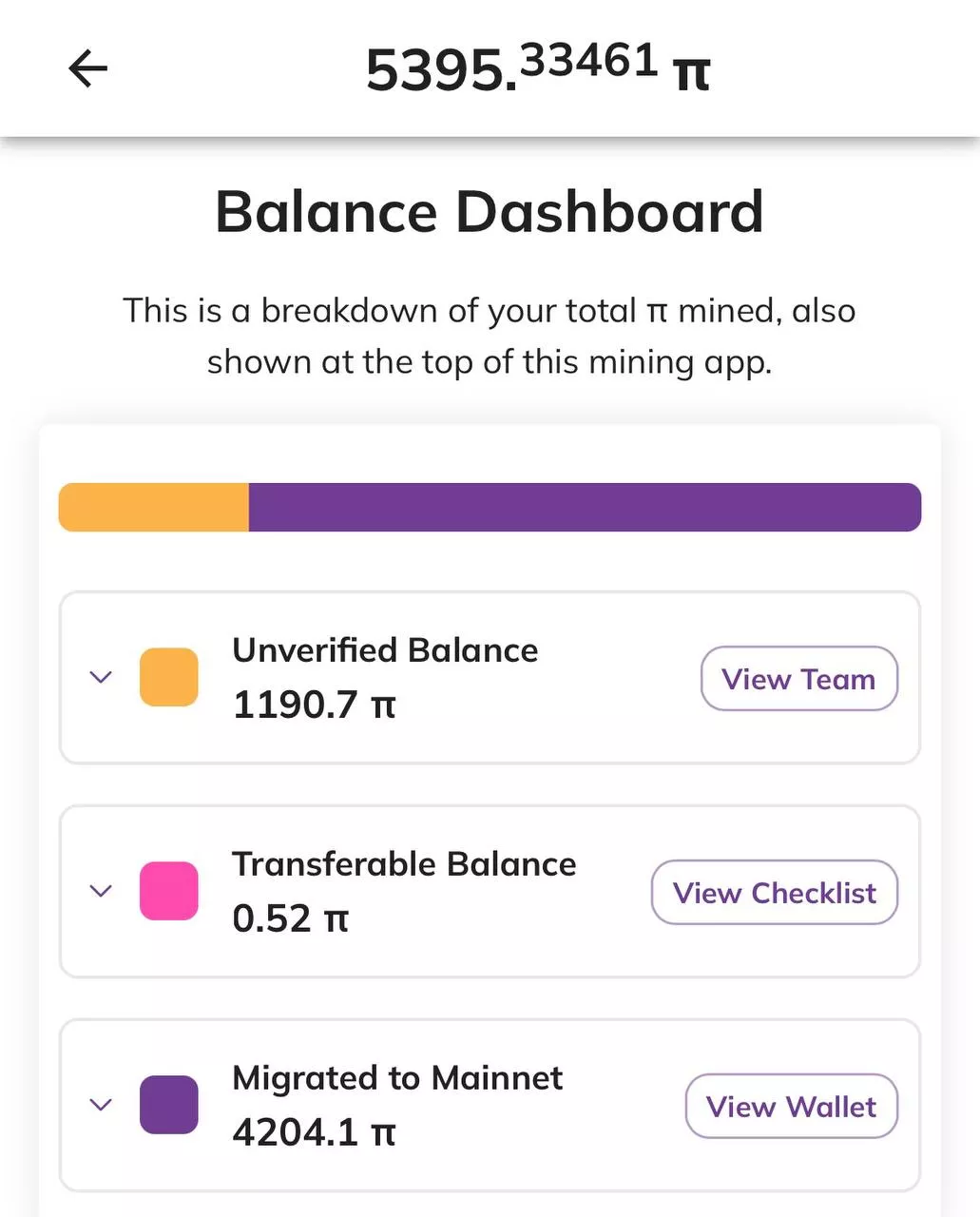
Pi Token Distribution: Migrations and KYC Rewards
Pi enforces a maximum supply of 100 billion $PI, with 65% allocated for community mining. To prevent an instant market collapse, the protocol throttles the circulating supply through paced Mainnet migrations and mandated lockups.
In 2026, Pi significantly advanced its distribution mechanisms. Following the deployment of second migrations (which unlocked secondary transferable balances and referral bonuses from KYC-verified downlines), the protocol completed its massive KYC Validator reward distribution in April 2026.
During this first round, over 1 million human validators processed 526 million identity checks. Validators were compensated at a rate of approximately 0.0504 $PI per successful validation—funded by a community pool and a 10 million $PI Foundation supplement. This decentralized human-verification workforce remains a unique, albeit slow, utility driver for the network.
Mobile & Node Mining Mechanics
Mobile Mining: The mobile flow operates on a simple attention economy loop. Users ping the app every 24 hours to prove active participation. Rewards are calculated based on a decaying base rate, bolstered by multipliers from Security Circles, active referrals, and long-term token lockups.
Node Mining: For advanced users, the Pi Node software (now Pi Desktop) allows participants to run SCP nodes on Mac or Windows. Node operators contribute to consensus and network health, but unlike standard PoS validation, the exact algorithmic payout for running a Pi Node remains historically opaque. It demands consistent uptime and port forwarding, making it suitable only for dedicated ecosystem believers.
Time vs Reward: Is $PI Worth It?
If you evaluate $PI purely on opportunity cost, mobile mining is a rational play. It takes less than five seconds a day and costs zero capital. However, if you are a DeFi power user accustomed to rapid liquidity and high-yield farming, Pi's multi-year wait times and mandatory KYC gates will feel highly restrictive.
| Task | Time Needed | Reward View |
|---|---|---|
| Daily mobile mining | Under 10 seconds per day | Low effort, but relies on a steeply declining base rate. |
| KYC and Mainnet Checklist | Varies (can face queue delays) | An absolute prerequisite for realizing any liquid value. |
| Node setup | 30–90 minutes + continuous uptime | Requires stable hardware; payouts are opaque compared to standard PoW/PoS. |
| KYC validator tasks | Ongoing manual labor | Demonstrated historical payouts (~0.05 PI per task), but highly tedious. |
Risks & Things to Watch
- Supply Overhang: With a 100 billion max supply, the market capitalization required to sustain high token prices is astronomical. Expect heavy sell pressure as more migration queues clear.
- Migration Bottlenecks: Despite the Open Network launch, millions of users remain stuck in KYC or migration queues. Value realization is not instantaneous.
- Closed Ecosystem Fatigue: While Open Network allows external connectivity, the protocol historically struggles to attract deep external liquidity or top-tier DeFi developer talent compared to EVM chains or Solana.
- Phishing & Seed Phrase Theft: Because the user base leans heavily retail, scammers relentlessly target Pioneers. Never input your Pi Wallet passphrase outside of the official Pi Browser app.
Start Pi Mining With an Invite
Pi Network remains gated by invitations. Use the button below to bypass the gate, download the official application, and initiate your zero-capital mobile mining.
Join Pi NetworkReferral disclosure: This is a referral link. The inviter may receive mining-related multiplier benefits if you join, mine, and complete KYC. Rewards are not guaranteed.
Pi Network Airdrop FAQ
Is the Pi airdrop real?
Yes, but it is a continuous mining and migration process rather than a traditional snapshot airdrop. Users must earn $PI off-chain and clear strict KYC hurdles to migrate it to the Mainnet.
Can I still mine Pi on mobile?
Yes. Mobile mining remains active, though the algorithm heavily favors early adopters by continuously halving the base mining rate as the network scales.
Does Pi node mining give rewards?
Node operators do receive bonus modifiers applied to their migration balances, but unlike standard Ethereum or Solana validators, there is no transparent, fixed APY table for node operators.
When is the next Pi token distribution?
Following the Open Network launch in 2025, secondary migrations and KYC Validator payouts (starting April 2026) are actively rolling out, though user-specific timelines are dictated by network queue processing.
Is Pi Network safe to join?
The core application is safe and costs zero capital to operate. The primary danger lies in social engineering: never expose your 24-word Pi Wallet passphrase to third-party websites claiming to offer accelerated migrations or token swaps.
Direct link to official project page
Get curated airdrop updates
Weekly AirdropBuzz highlights, safety notes, and top picks-no spam.
Explore Airdrop Lists
Community Discussion & Rating
Leave a Comment & Rate
Login to join the discussion.
Registered AirdropBuzz users can comment and rate airdrops. Your display name is taken from your dashboard profile.
No comments yet. Be the first to share your thoughts!