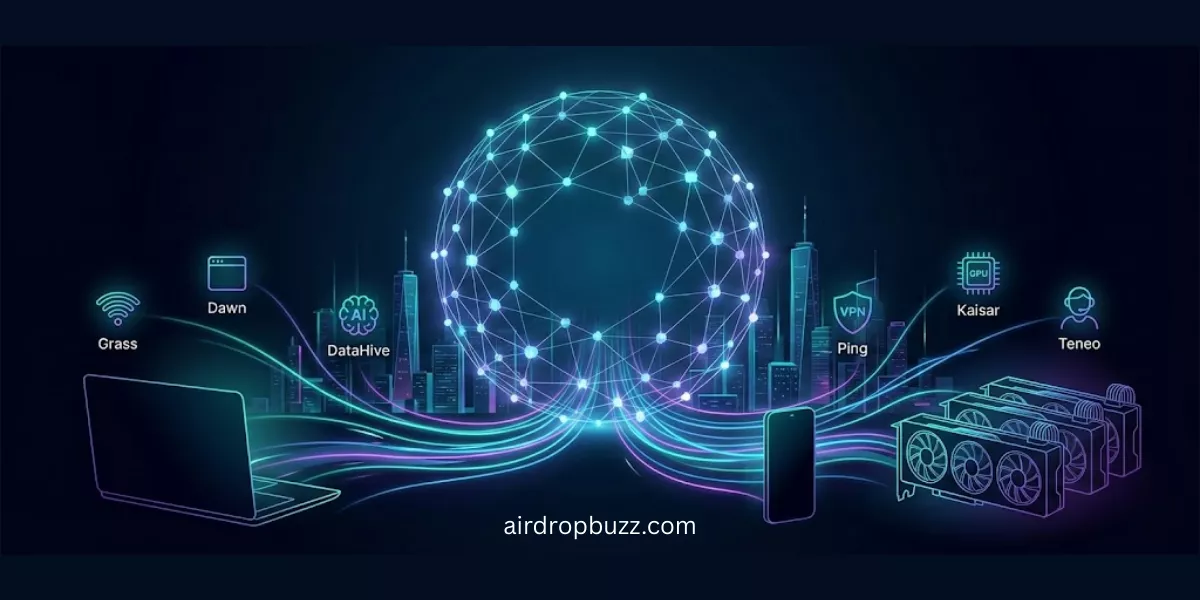
DePIN went from “weird Helium cousin” to one of the main narratives heading into 2026. Instead of copy-paste DeFi farms, we finally have projects that pay you for real-world work: bandwidth, data, and compute. The AirdropBuzz team has been running nodes, browser extensions, and GPU clients across the DePIN stack – and in this guide we’re zooming in on six 2026-ready airdrops we actually use: Grass, Dawn Internet, DataHive AI, Ping Network, Kaisar Network, and Teneo.
| Time Required | Cost | Risk Level | Our Verdict |
|---|---|---|---|
| ~45 minutes to onboard all 6; ongoing uptime is passive | $0 – no token deposits; just bandwidth, data & power | Medium (browser extensions, data sharing, mostly pre-TGE) | One of the best asymmetric plays for DePIN exposure in 2026 if you’re already online all day. |
| UX Score (/10) | Earning Potential (High/Med/Low) | Reward Certainty (Confirmed/Speculative) |
|---|---|---|
| 8/10 (extensions & apps feel mature vs typical “beta” nodes) | High (if DePIN & AI narratives continue this cycle) | Mixed: some tokens live; others still speculative point-to-token plays |
What Is DePIN & Why These 6 Projects Matter in 2026?
DePIN (Decentralized Physical Infrastructure Networks) is about using token incentives to crowdsource real-world infrastructure – wireless coverage, storage, compute, bandwidth – from normal people instead of a few giant data centers. You plug in devices, run a node, or share resources, and earn rewards for providing verifiable “physical work” to the network.
By early 2026, DePIN has clearly split into two big buckets: Physical Resource Networks (think sensors, routers, hotspots) and Digital Resource Networks (bandwidth, compute, data). The six airdrops we’re focusing on sit squarely in the digital camp, and each has its own deep-dive on AirdropBuzz:
- Grass – bandwidth-sharing protocol where your browser/desktop app turns idle internet into points and $GRASS exposure.
- Dawn Internet – Solana-powered decentralized broadband network; you earn Dawn Points with a Chrome validator extension and, eventually, DAWN hardware routers.
- DataHive AI – AI data DePIN: your browsers and Android devices collect anonymized public web data in exchange for points that should later convert into tokens.
- Ping Network – Solana-backed universal bandwidth layer; contributors share connectivity via a VPN-style app and farm Ping Points now for a future token.
- Kaisar Network – GPU DePIN and Layer-1 for AI compute, built on peaq. Users farm KAI via the ZeroNode browser platform today and can later plug in real GPUs and Checker Nodes.
- Teneo Protocol – decentralized AI agent network that structures real-time open-web data using browser-based Community Nodes and “Machine ID” agents, with points and Gold NFTs for early contributors.
On the leadership side, these aren’t anon meme coins. Grass, Dawn Internet, DataHive AI, Ping Network, Kaisar, and Teneo all have public-facing founders, advisors, or backers, which we break down in each individual review. When a team hasn’t fully doxxed themselves in a verifiable way, we simply state: “The development team has not publicly disclosed their identities.” We never guess or speculate.
As of early 2026, all six campaigns are active with fresh updates on AirdropBuzz – this is our short list for serious DePIN time allocation this year.
Our Experience Joining These DePIN Airdrops
The AirdropBuzz team doesn’t publish DePIN guides from the sidelines – we run the same stuff our readers do. Every one of the six projects above has a dedicated, hands-on review:
- Grass Airdrop Season 2 Review
- Dawn Internet Airdrop Review
- DataHive AI Airdrop Guide
- Ping Network Airdrop Guide
- Kaisar Network DePIN GPU Guide
- Teneo Airdrop Guide
Those pages are written after we’ve gone through onboarding, watched points tick up, and lived with the software for a while. In short, here’s how each one actually feels:
- Grass: Easiest on the list. Browser extension / desktop app, no KYC, no token deposit. Once connected, it’s genuinely “set and forget” – we’ve run it on spare laptops and work machines without noticing performance issues, while points accumulate toward ongoing seasons.

- Dawn Internet: Slightly more involved because of the dedicated Chrome Validator extension and DAWN dashboard account, but still pure browser territory. Setup was roughly 10–15 minutes in our testing, after which uptime and social quests (X, Discord, Telegram) drove most of the points.

- DataHive AI: One of the smoothest DePIN clients we’ve used. The Chrome extension and Android app both install like normal web2 products; the extension stayed lightweight and barely used CPU in our tests, even while streaming video. The multi-device dashboard (PC + phone) feels very “SaaS,” not degen.

- Ping Network: Feels like a consumer VPN with a points engine bolted on. Mobile apps and the Chrome extension generate points per hour of uptime, and referral boosts are clearly reflected in the app’s Earn tab. Users who stay connected and stack boosts separate themselves quickly from casuals.

- Kaisar Network: Higher-friction but higher-upside. ZeroNode onboarding involves an account, browser extension, wallet binding, socials, and daily missions – more “gamified questing” than passive farming. Once you step up to GPU Provider or Checker Node, it starts feeling like a real side business rather than a background airdrop.

- Teneo Protocol: Somewhere between browser farm and builder playground. You run a Community Node in your browser, mint a Machine ID tied to your wallet, and let the Agent do its thing while you browse. Golden Agent Ticket NFTs, Agent Insights, and on-chain Machine IDs add more moving parts, but the experience is surprisingly polished.

Across all six, the pattern is clear: around 45 minutes of focused setup time can put you in position to farm bandwidth (Grass, Dawn, Ping), data (DataHive, Teneo), and compute (Kaisar) simultaneously – all while you use your devices normally.
Time vs Reward: Are DePIN Airdrops Worth Your 2026 Screen Time?
The question we always come back to is simple: if you give these projects your time, connectivity, and hardware, what’s the realistic upside? Let’s break it down by project and by user type.
Grass – The Passive Bandwidth Blue-Chip
Profile: Bandwidth DePIN – browser/desktop app, token already live, seasonal reward programs ongoing. Full breakdown in our Grass Season 2 airdrop review.
- Time Cost: 5–10 minutes to install and connect, then pure passive uptime.
- Capital Cost: None, apart from bandwidth and electricity.
- Upside: Token already trades and a large portion of supply is earmarked for community rewards, so Grass feels less “will they launch?” and more “how big will your slice be?”
- Who should farm: Anyone with always-online PCs or spare laptops. If you only pick one bandwidth farm for 2026, Grass is the default.
Our 2026 view: High conviction DePIN bandwidth play with relatively clear token mechanics. If you like asymmetric bets where your downside is basically “I burned a few watts of power,” Grass belongs on your shortlist.
Dawn Internet – Solana DePIN with Hardware Optionality
Profile: Solana broadband DePIN; earn Dawn Points via Chrome extension, referrals, and (later) DAWN routers. All the details live in our Dawn Internet airdrop review.
- Time Cost: Around 15 minutes setup; ongoing uptime plus occasional quests.
- Capital Cost: Browser farming is free; hardware miners are optional and speculative.
- Upside: No confirmed tokenomics or TGE details; points are widely expected to matter, but conversion ratios and allocations are still TBA.
- Who should farm: Desktop-heavy users who like Solana and are comfortable running another validator-style extension.
Our 2026 view: Strong narrative (user-owned broadband on Solana) and respectable UX, but reward certainty is lower than Grass or Kaisar. We treat Dawn as a mid-to-high-upside speculative farm, sized by your trust in the team and in Solana DePIN.
DataHive AI – Passive AI Data Yield for Power Browsers
Profile: DePIN data network for AI training – Chrome extension + Android app, with a clear points system. We break it down in our DataHive AI airdrop guide.
- Time Cost: About 15 minutes to connect browser and phone, then largely passive.
- Capital Cost: No deposits; you “pay” with anonymized public web data and device uptime.
- Upside: Point-to-token model is confirmed, but token ticker and allocations are still TBA. This adds uncertainty, but serious backers and a fast-growing community suggest they’re building for a real launch rather than a farm-and-forget campaign.
- Who should farm: People already running Grass/Ping/Dawn who want to layer one more passive client on top, especially if they own both desktop and Android devices.
Our 2026 view: Among pre-token DePIN plays, DataHive sits in the top tier. It’s low-friction, low-risk (no deposits), but high optionality if AI data infra keeps heating up. We rank it alongside Grass and Kaisar in terms of time/effort priority.
Ping Network – Mobile-First Bandwidth with Strong Referral Loops
Profile: Decentralized bandwidth marketplace on Solana; VPN-style app on iOS, Android and Chrome earning points per hour plus boosts and referrals. See our Ping Network airdrop guide for app screenshots and latest quests.
- Time Cost: 5–10 minutes to install and verify, then uptime plus occasional quests and community events.
- Capital Cost: None; again, bandwidth and electricity only.
- Upside: Future token is confirmed but not yet live; Ping Points are designed to seed TGE allocations, subject to final tokenomics. A good referral strategy can significantly increase your upside.
- Who should farm: Anyone who already uses a VPN or keeps a phone/PC online all day; especially strong for users who can invite large friend groups.
Our 2026 view: High-quality DePIN farm, but still in the “unpriced future token” camp. Ideal as part of a DePIN basket: run Ping alongside Grass and Dawn and think of them as one big bandwidth index play.
Kaisar Network – GPU DePIN with Real Skin in the Game
Profile: GPU DePIN and L1 chain on peaq; ZeroNode browser extension for entry-level farmers plus GPU Provider and Checker Node roles for power users. KAI token already exists with a capped supply and Proof-of-Physical-Work emissions. We cover it in depth in the Kaisar Network DePIN & AI GPU guide.
- Time Cost: 20–30 minutes to fully set up ZeroNode (account, extension, missions, wallet and socials), more for advanced roles.
- Capital Cost: ZeroNode itself is free; GPU Provider and Checker Node roles can involve real hardware and, potentially, licenses.
- Upside: This isn’t a “maybe they’ll launch a token” situation – KAI is already live. Your question is how much of the long-term emissions you can capture by being early and active.
- Who should farm: Two groups: (1) casual DePIN farmers via ZeroNode who want exposure to GPU infra without owning hardware, and (2) GPU miners or data centers looking to monetize spare compute.
Our 2026 view: Higher friction, but also one of the most “real” DePIN plays in this list. If you believe AI compute is the new oil, Kaisar is exactly the sort of project where early network contributors can be meaningfully rewarded.
Teneo Protocol – For People Who Want Data & Airdrop Exposure
Profile: DePIN + AI agent network; browser-based Community Node, Machine ID, Agent Insights, and Golden Agent Ticket NFTs for deeper participation. Our full walkthrough lives in the Teneo airdrop guide.
- Time Cost: 15–20 minutes to connect wallet, create Smart Account, mint Machine ID, and spin up your Agent.
- Capital Cost: None for the base node; your wallet stays non-custodial.
- Upside: Points and Gold NFTs are clearly designed to funnel into future rewards, but the exact token mechanics are TBA. Teneo’s focus on real-time social and web data makes it an interesting hedge next to more straightforward bandwidth farms.
- Who should farm: Users who like tinkering, dashboards, and the idea of running AI agents – not just passive bandwidth sharing.
Our 2026 view: Teneo isn’t the simplest on this list, but it’s one of the most “future facing.” If you want exposure to DePIN x AI agents and don’t mind slightly more complex UX, this is a strong side quest with meaningful upside if they nail token design.
Risks & Things to Watch
DePIN feels safer than locking five figures into some random DeFi farm, but it’s not risk-free. A few things we always highlight in our internal checklist:
- Browser extension risk: Grass, Dawn, DataHive, Ping, and Teneo all use extensions or always-on apps. That’s extra code with deep access to your browsing environment. Only install from official store listings and verified links, like the ones in our AirdropBuzz guides:
- Data sharing & privacy: DataHive and Teneo explicitly monetize public web data; Dawn, Grass, and Ping route bandwidth. These teams emphasize anonymization and privacy, but you’re still trading data for potential future tokens. Use separate browser profiles or devices if you’re cautious.
- Speculative rewards: Except for tokens that are already live, all rewards are points, not guaranteed tokens. TGE dates, allocations, and vesting are mostly TBA, even where point-to-token conversion is hinted or confirmed. Treat your time as a speculative investment, not guaranteed income.
- Hardware escalation: Projects like Dawn (hardware routers) and Kaisar (GPU & Checker Nodes) will tempt you to buy hardware. Don’t do that just for an airdrop unless you can model real, post-TGE economics and you’re comfortable with the risk.
- Regulatory & KYC creep: Some DePIN networks eventually add KYC for large payouts or commercial usage. None of the six currently require exchange-style KYC for basic participation, but this can change, so stay flexible.
As always: this is not financial advice. DePIN airdrop farming is still crypto – there’s smart-contract, market, and opportunity-cost risk. Size your time and hardware exposure accordingly and always DYOR.
Step-by-Step Guide: How to Join These DePIN Airdrops
Here’s how we’d stack these six campaigns if we were starting from zero in early 2026.
- Prepare your DePIN setup
- Pick a main desktop or laptop that stays online for several hours a day.
- Create a separate browser profile (or even a dedicated browser) specifically for DePIN extensions.
- Have a non-custodial wallet ready (for example, an EVM wallet) for Kaisar and Teneo.
- If you have an Android phone, keep it handy for DataHive and Ping.
- Start with the pure passive bandwidth farms
- Grass: Open our Grass Season 2 airdrop guide, follow the link to the official app, install the browser extension or desktop client, connect, and let it run in the background.
- Ping Network: From the Ping Network airdrop guide, install the app (Android/iOS/Chrome), enter any referral code you want to use for boosts, and keep the app connected whenever you’re online.
- Dawn Internet: Use the Dawn Internet airdrop review to reach the official dashboard, create an account, install the Dawn Validator Chrome extension, and keep your browser online to earn Dawn Points.
- Add the AI data farms
- DataHive AI: Open the DataHive AI airdrop guide, go to the official site, install the Chrome extension, sign in, and (optionally) install the Android app with the same account for extra points. Connect Telegram and X/Twitter via the dashboard for one-time boosts.
- Teneo Protocol: Use our Teneo airdrop guide to access the official dashboard, connect your wallet, create your Smart Account, run the Community Node in your browser, mint your Machine ID, and set your Agent to contribute.
- Plug into GPU DePIN with Kaisar
- Open the Kaisar Network DePIN & AI GPU guide and go through the ZeroNode registration flow step by step.
- Install the ZeroNode browser extension, bind your wallet, connect Discord/Twitter, and start completing missions and daily check-ins.
- If you own GPUs, read carefully through the provider and Checker Node sections in that guide before committing hardware or capital.
- Set your daily/weekly DePIN routine
- Once a day: verify that all extensions and nodes are online and earning.
- Once a week: check each project’s dashboard for new quests, boosts, or campaigns (especially Ping, Dawn, DataHive, and Teneo).
- Every few weeks: skim the six AirdropBuzz articles above for any TGE or tokenomics updates and for changes in our internal “Potential” view.
- Stay safe & avoid shortcuts
- Only use links from AirdropBuzz or official project channels.
- Ignore scripts, bots, or “boosters” that promise supercharged points – they’re how accounts get banned or wallets get drained.
- Keep DePIN experiments away from your main trading wallets and high-value accounts.
If you follow the stack above, by the end of a single afternoon you’ll be farming six of the strongest DePIN airdrop plays for 2026 – with minimal ongoing effort and broad exposure across bandwidth, data, and compute.
Ready to Go All-In on DePIN?
Our team keeps the DePIN list on AirdropBuzz updated as new bandwidth, compute, and data networks launch. If you want to stay ahead of the next Grass, Dawn, or Kaisar, don’t stop at just one guide.
Explore All DePIN AirdropsReferral Disclosure: We may earn points or rewards if you use links from our DePIN category pages. Supporting us helps fund more deep-dive testing and safety research – but you should always choose the projects that fit your risk profile.
DePIN Airdrops 2026 – FAQ
Are these DePIN airdrops really free to join?
Yes in the sense that you don’t need to deposit tokens into a smart contract to participate in Grass, Dawn, DataHive, Ping, Kaisar ZeroNode, or Teneo. Your “cost” is uptime, bandwidth, some anonymized data, and electricity for the devices you leave online. Optional hardware (like broadband routers or GPUs) is where real capital risk starts, and you should only consider that after thorough research.
When are the airdrop snapshots and TGEs for these projects?
Only parts of this basket are “post-TGE” today. Some projects already have live tokens, while others are still in point-farming mode with TGE dates and precise snapshot rules yet to be announced publicly. Even where teams confirm or hint at point-to-token conversions, exact allocation and timing remain TBA. Always treat points as speculative until official tokenomics are published.
Are these airdrops “confirmed” or just rumors?
They’re more than rumors, but not all equal. A couple of networks already have live tokens and clear roles for contributors. Others have explicitly committed to rewarding point holders with tokens. A few are openly running points and NFT programs intended to seed future rewards, but without full public tokenomics yet. The AirdropBuzz approach is to farm them as a basket, assume nothing is guaranteed, and let the winners pay for the duds.
Which DePIN airdrop should I prioritize if I have very limited time?
If you can only handle a tiny setup window, we’d start with Grass and DataHive for pure “install and forget” value, then add Ping on mobile if you can. Once those are running, use your next free hour to onboard into Kaisar ZeroNode for GPU exposure, then Dawn and Teneo as you get more comfortable. That order balances UX, upside, and the maturity of each project in early 2026.
How do I stay safe while farming multiple DePIN airdrops?
Use a dedicated browser profile or device for all DePIN extensions, keep your main trading wallets separate, and never install clients from unofficial links. Regularly review extension permissions, follow each project’s official channels for updates, and lean on the AirdropBuzz safety checklist before committing serious time or hardware. If something feels off – weird permissions, unofficial “boost” tools, or unsolicited DMs – skip it. DePIN rewards aren’t worth losing your main wallet.