TL;DR / Key Takeaways
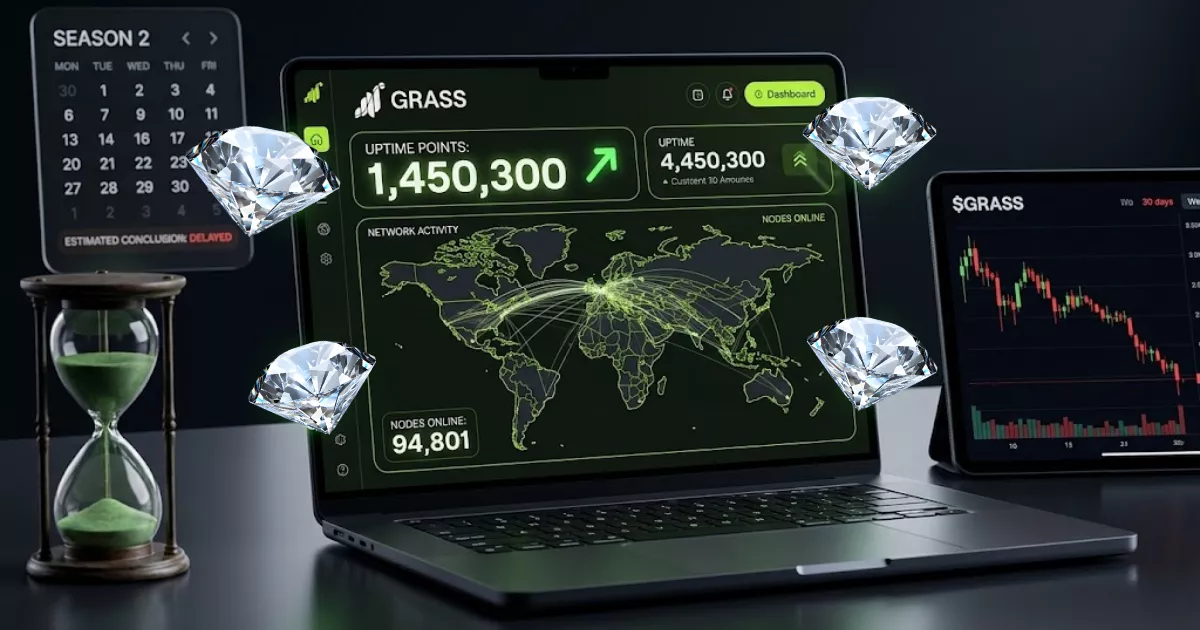
- Grass Season 2 is still live because the team has not set a final end date and the reward system is still being refined.
- Season 2 is taking longer than Season 1 because Grass now weighs real bandwidth usage, not just simple uptime.
- The GRASS token price is low because launch hype faded, more tokens are circulating, and users are still waiting on clear Season 2 catalysts.
- Season 2 could have a bigger total token pool than Season 1, but that does not guarantee bigger rewards per user.
- Grass has not shared a final point-to-token conversion, so any exact ratio right now is still speculation.
- A realistic Season 2 payout will likely depend on weighted contribution, not just raw point totals.
- Grass Diamonds appear to reflect real network demand and may help measure stronger contributors.
- Diamonds do not look like a separate tradable token right now and should be treated as an internal reward signal.
- Grass remains easy to farm because it is mostly passive, but the long wait makes it a patience-based airdrop.
- The safest approach is to keep farming, track official updates, and avoid trusting unofficial conversion leaks.
On this page Jump straight to the sections you need Built for mobile reading and quick skimming.
Grass Season 2 is still one of the easiest background airdrops to farm, but it is also one of the most confusing right now. The big questions are fair. Why is it still running? Why does it feel slower than Season 1? Why is the GRASS price weak? And do Diamonds actually matter? In this guide, The AirdropBuzz Team breaks down what is confirmed, what is still TBA, and what a realistic Season 2 payout could look like.
| Our verdict | Grass still looks worth farming for patient users, but Season 2 is no longer a simple “leave it on and pray” setup. Real network usage matters more now. |
|---|---|
| Confirmed? | Yes. Another Grass token distribution is part of the project plan, but the finish line and exact rules are still not fully published. |
| Why the wait? | The network is much bigger, the reward model got more complex, and Grass has tied Airdrop 2 to a new wallet flow inside the dashboard. |
| Who this suits | Users with stable internet, low patience for daily quests, and enough time to let a background app run for months. |
| Who should skip | Anyone who wants a fast claim date, fixed conversion, or a short farming cycle. |
| Test area | Score | Why |
|---|---|---|
| Setup speed | 9/10 | Fast sign-up and simple install flow. |
| Daily effort | 9/10 | Very low. This is mostly passive. |
| Cost | 10/10 | No trading or bridging needed. Bridging means moving money from one chain to another. |
| Reward clarity | 4/10 | The biggest weak spot. Season 2 still has no final public conversion formula. |
| Fairness | 7/10 | Better than pure referral farming because actual bandwidth usage now matters more. |
| Patience required | 3/10 | Easy farm, long wait. |
What is Grass?

Grass is a decentralized physical infrastructure network that rewards users for sharing unused internet bandwidth. DePIN means a crypto network built from real-world things like devices, bandwidth, storage, or sensors. In plain English, Grass lets people rent out a small unused part of their home or mobile internet connection so the network can route web data requests through it. In return, users earn points that may turn into GRASS token rewards later.
That matters because Grass is not pitching itself as a meme coin with a browser extension on top. It is trying to build real data and routing infrastructure for AI and web data products. The GRASS token already has a live staking role, where holders can delegate tokens to routers that help secure and operate the network. Grass has also said it wants more token use across routing, settlement, and network operations over time.
Founder verification matters here. Andrej Radonjic is the public face most closely tied to the project. Grass’s official channels have described him as co-founder and CEO, and his LinkedIn profile lists him as a founder at Wynd Labs, the service company that supports Grass.
Our Experience Joining Grass
For this update, The AirdropBuzz Team reviewed the live onboarding flow, the current reward docs, the staking docs, and the latest public project updates. We are not pretending we ran a brand-new wallet for months just to write a cooler story. The setup still looks light. Sign up, install the app or extension, stay connected, and let the dashboard track your progress.
The big change is not the join flow. It is the reward logic. Grass now separates simple uptime from actual bandwidth usage. That makes Season 2 feel more “real,” but also more uneven. Two users can both stay online for long hours and still end up with very different results if one connection gets used by the network more often.

Is Grass Season 2 airdrop confirmed?
Yes, the next Grass token distribution is real. What is still missing is the final public playbook. Grass has said future token drops happen at intervals chosen by the Foundation, and it has also said Airdrop 2 will be tied to a new native wallet inside the dashboard. So the drop is not the mystery. The mystery is the exact finish date, claim flow, and weighting rules.
Why Grass Season 2 has not ended yet
The short answer is that Grass has not posted a final end date yet, and the team has been rebuilding the reward framework while the network keeps growing. That is why the season feels “stuck” even though it is still moving.
There are three big reasons. First, Grass now wants rewards to match real contribution more closely. Second, the next token distribution is tied to a new wallet system inside the dashboard, which adds extra product work before claims can happen. Third, the network is much larger now than it was around Airdrop One, so sorting users, filtering weak activity, and making a fair payout takes more work.
Why Grass Season 2 is taking longer than Season 1
Season 1 was mostly about building the map. Get users online. Track uptime. Grow referrals. Reward early believers. Season 2 is more about quality. Grass has already shifted the scoring system so actual bandwidth usage matters, not just being connected. That is a harder system to run and a harder system to settle.
There is also a scale problem. A bigger network sounds great, but it slows reward design. More users means more edge cases, more inactive accounts, more low-quality traffic, and more pressure to stop the drop from feeling unfair. Grass has also said Airdrop 2 will better match long-term contribution. That usually means extra filtering, extra weighting, and extra delay.
So yes, Season 2 is taking much longer than Season 1. But it is not just “the team forgot.” It looks more like Grass moved from simple growth rewards to a more selective model based on actual network usefulness.
Why GRASS token price is low right now
GRASS looks cheap today mostly because the market is comparing it with its old launch hype, not just its current business. After launch, early price action set a very high bar. Since then, the token has had to deal with unlock pressure, uncertain timing around Season 2, and the usual post-airdrop selling from users who just want to cash out.
There is also a supply story. More tokens are in circulation now than near launch, and that usually makes it harder for price to hold the same premium unless demand grows just as fast. Grass does have real utility through staking and router participation, which helps the long-term case, but the market usually wants clear near-term catalysts too. A delayed Season 2 and unclear conversion model do not help sentiment.
That said, “low” depends on what you compare it with. If you compare GRASS with its old peak, it looks crushed. If you compare it with its recent lows, it looks less dramatic. The clean read is this: the token is trading far below its old high because supply, waiting fatigue, and weaker hype have beaten the story for now.
Could Grass Season 2 distribution be bigger than Season 1?

Yes, it could. But that does not automatically mean each user gets more.
Season 1 distributed 100 million GRASS. Grass also has a larger community rewards bucket that still leaves room for future incentive programs. So on paper, a Season 2 drop bigger than Season 1 is possible. That is the bullish case people keep pointing to.
Here is the catch. A bigger headline pool can still lead to a smaller payout per person if the network is much bigger and the scoring is more diluted. That is exactly the risk in Season 2. Even if the next pool beats 100 million GRASS, the per-user outcome could still feel smaller because more people are farming and the reward model now looks more selective.
Our view: a bigger-than-Season-1 distribution is possible, but you should not read that as “my bag will be bigger too.” Pool size and personal allocation are not the same thing.
Grass point to token conversion: what could it look like?
Grass has not published a final Season 2 point-to-token formula. So any hard ratio floating around social media is still guesswork. The safe way to think about it is this:
Your Season 2 tokens = your weighted share of the final Season 2 reward pool.
The key word is weighted. Not all points may matter the same way. If Grass leans harder on real usage, then simple uptime points may carry less weight than many farmers expect, while Network Points or the dashboard metric people call Diamonds may matter more.
| Scenario | Season 2 pool | Total weighted Season 2 score | Value of 1,000,000 weighted points |
|---|---|---|---|
| Conservative | 50,000,000 GRASS | 200,000,000,000 | 250 GRASS |
| Mid case | 75,000,000 GRASS | 150,000,000,000 | 500 GRASS |
| High case | 100,000,000 GRASS | 100,000,000,000 | 1,000 GRASS |
This is not a leaked formula. It is a simple model to show how the math works. The main point is easy to miss: your raw point count alone does not tell the whole story if Grass adds stronger weighting for actual network usage, location quality, or connection reliability.
What do Grass Diamonds do?
Diamonds are best understood as the “real demand” side of Grass Season 2, not as a separate token you can spend. In the refreshed reward model, Grass formally talks about Uptime Points and Network Points. Uptime Points track that you stayed online. Network Points track when your connection was actually used to serve web requests. That is the part many users now describe as Diamonds inside the dashboard.
So what is the use case? Right now, Diamonds look useful in three ways. First, they show whether the network actually wants your bandwidth. Second, they help Grass reward quality over empty farming. Third, they likely help the team sort strong contributors from users who were just online but rarely useful.
What Diamonds do not look like today is a separate on-chain asset with its own market, claim page, or spend menu. No standalone redemption flow has been announced. So treat Diamonds as a signal inside the reward system, not a second token.
Time vs Reward: Is GRASS Worth It?
For most users, the best part of Grass is still the low grind. This is not a quest board where you click through twenty tabs every day. Setup takes a few minutes. Daily effort is close to zero after that. The hard part is the wait.
That makes Grass a weird value trade. Your time cost is low, but your patience cost is high. If you already keep a laptop, desktop, or phone online for long stretches, Grass is still one of the easier background farms to keep running. If you hate vague payout dates, then Season 2 will feel slow and annoying.
Our honest take: GRASS is still worth farming if you can treat it like a passive long game. It is less worth it if you are checking the dashboard every day hoping for a quick conversion announcement.
Risks & Things to Watch
- Season 2 end date: still TBA.
- Conversion risk: no final public point-to-token formula yet.
- Weighting risk: actual bandwidth usage may matter much more than plain uptime.
- Price risk: even a big drop can feel small in dollar terms if GRASS stays weak.
- Eligibility risk: payout rules can vary by jurisdiction, so always check official Grass Foundation terms.
As always, DYOR. Do not buy accounts, fake activity, or trust random “guaranteed ratio” posts on social media.
Step-by-Step Guide: How to Join Grass
- Open the Grass sign-up page using a valid referral link and create your account.
- Download the Grass app or extension for the device you plan to keep online most often.
- Log in and confirm the app is connected.
- Let Grass run in the background so you can build uptime over time.
- Check the rewards dashboard to track your progress. Watch both basic uptime progress and the real-usage side of your rewards.
- Keep your connection stable. A clean, steady connection is more useful than random short sessions.
- Wait for official instructions on the next distribution flow and wallet setup inside the Grass dashboard.
Ready to start farming Grass while Season 2 is still open?
Set it up once, let it run, and start stacking points while the next distribution is still being built.
Join Grass with our referral link
Disclosure: This is a referral link. If you sign up through it, The AirdropBuzz Team may receive referral benefits at no extra cost to you.
Grass Airdrop Season 2 FAQ
Is Grass Season 2 airdrop confirmed?
Yes. Grass has already said future token distributions will continue, but it has not posted the final Season 2 end date, claim date, or exact conversion formula yet.
Why is Grass Season 2 taking longer than Season 1?
Season 2 is being built around a more advanced reward model and a new wallet flow inside the dashboard. Grass also now tracks actual bandwidth usage more closely, which makes the system slower to finalize but more quality-focused.
Can Grass Season 2 be bigger than Season 1?
It can be bigger on paper, yes. But a bigger total pool does not guarantee a bigger personal payout because there are more users and likely stronger weighting around real contribution.
What are Grass Diamonds?
Diamonds appear to represent the real-usage side of Grass rewards. Think of them as proof that the network actually used your connection, not just proof that your device stayed online.
How might Grass points convert to tokens?
No final public ratio has been announced. The safest model is to think in shares: your weighted contribution divided by the full Season 2 weighted contribution, multiplied by the final token pool.