TL;DR / Key Takeaways
- A crypto airdrop distributes tokens to eligible users; it does not guarantee profit.
- Points, waitlists, allocations and open claims are different states.
- No-deposit entry can still lead to claim or withdrawal costs.
- PC and mobile access depend on the campaign and supported wallet.
- Verify the official rules and understand each request before signing.
On this page Jump straight to the sections you need Built for mobile reading and quick skimming.
A crypto airdrop is a distribution of tokens to eligible users or wallets. A project may reward past activity, invite community participation or distribute tokens to holders of another asset. Some distributions arrive automatically. Others require an eligible user to claim them through an official page.
The important question is what you can actually receive. A points balance, a waitlist position and a transferable token are different things. “Free to join” also does not tell you whether claiming, selling or withdrawing will cost money.
This guide explains the meaning of cryptocurrency airdrops, how the main types work and what to check before joining on a PC or phone. For a current campaign list, use AirdropBuzz’s latest airdrop guides; an educational article cannot establish that a particular claim is open today.
What does airdrop mean in crypto?
In crypto, an airdrop is a way to distribute an asset. It is not the same as Apple’s AirDrop file-sharing feature, a mining app or an interest-bearing deposit. The word describes the distribution, not a guarantee that the asset has a market price.
Projects can use airdrops to distribute governance rights, recognise users or introduce a product. Recipients may still face eligibility checks, claim deadlines or restrictions on when tokens can move. The published rules determine which of those conditions apply.
There is also an important warning: receiving a token you did not request does not prove you earned a legitimate reward. MetaMask’s airdrop phishing guidance explains how unsolicited tokens can lead users toward malicious claim sites.
The main types of crypto airdrops
| Type | How eligibility may work | What to verify |
|---|---|---|
| Retroactive distribution | A project rewards activity completed before a cutoff. | The snapshot, qualifying activity and whether new users can still qualify. |
| Holder distribution | Wallets holding a specified asset at a stated time may qualify. | The asset, network, balance rules and snapshot time. |
| Community or quest allocation | Published tasks help determine an allocation. | Whether tokens are committed, how entries are checked and how rewards are divided. |
| Points programme | Activity earns an internal score or points balance. | Whether the project has actually announced a token allocation or conversion. |
| Waitlist or early access | Users register interest or seek an invitation. | What access is offered. Registration alone does not establish a token reward. |
These labels sometimes overlap. A quest programme can award points and later announce a token distribution. Until that announcement exists, describe it as points participation rather than a confirmed payout.
Points, allocations and claimable tokens: know the difference
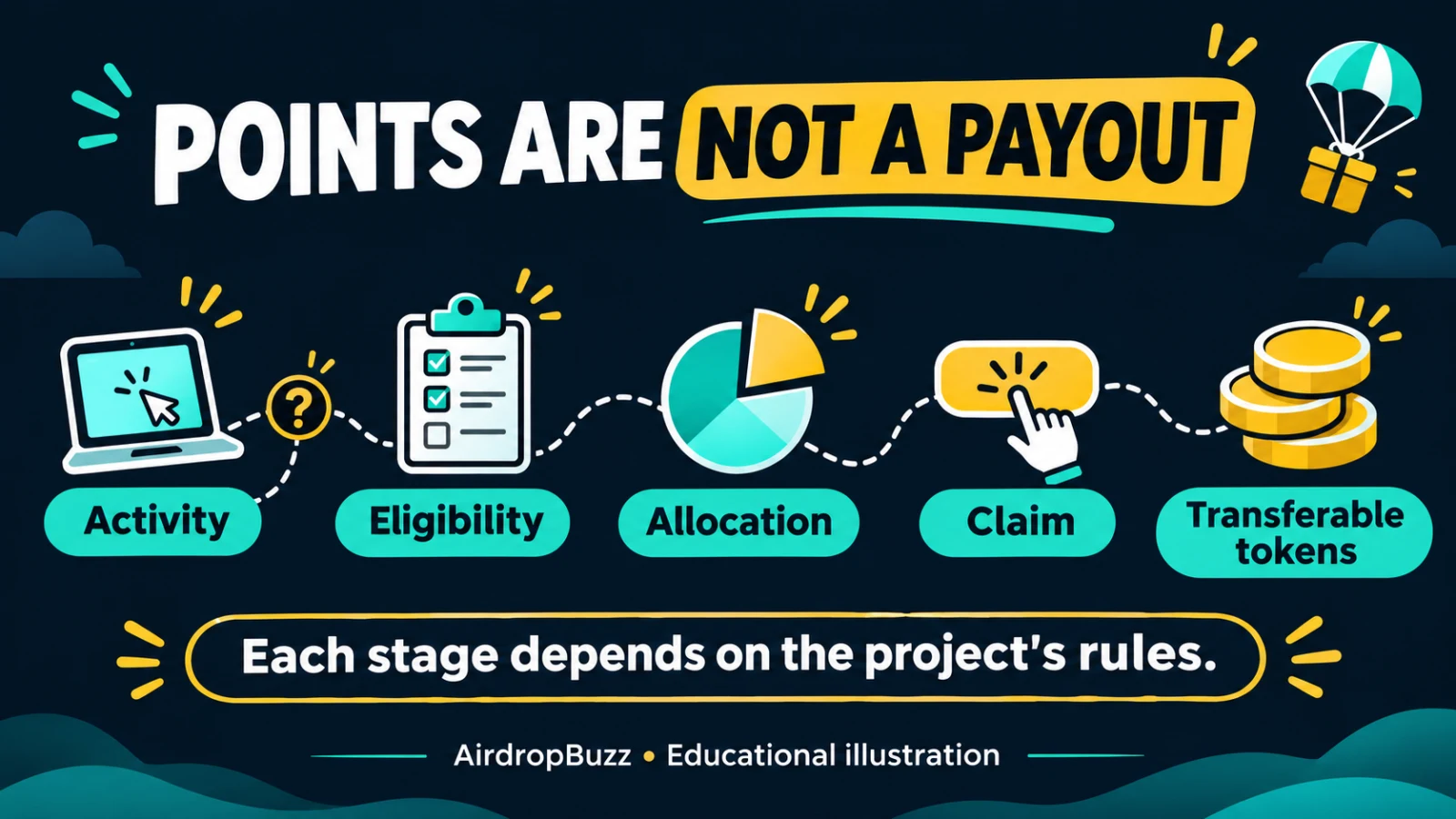
- Points: a score inside a programme. Unless rules specify otherwise, there is no established token conversion.
- Eligibility: your wallet or account meets the stated conditions. Eligibility may still depend on final checks.
- Allocation: an assigned quantity. It can be subject to vesting or other restrictions.
- Claimable: the official process currently lets an eligible participant request the available amount.
- Transferable: the tokens can move under the contract’s rules. That still does not establish a buyer or a reliable market price.
A token generation event, often shortened to TGE, does not automatically make every allocation claimable. Read the specific schedule. Our token vesting guide explains cliffs, unlocks and why an allocation can differ from the amount available to claim.
Are free crypto airdrops really free?
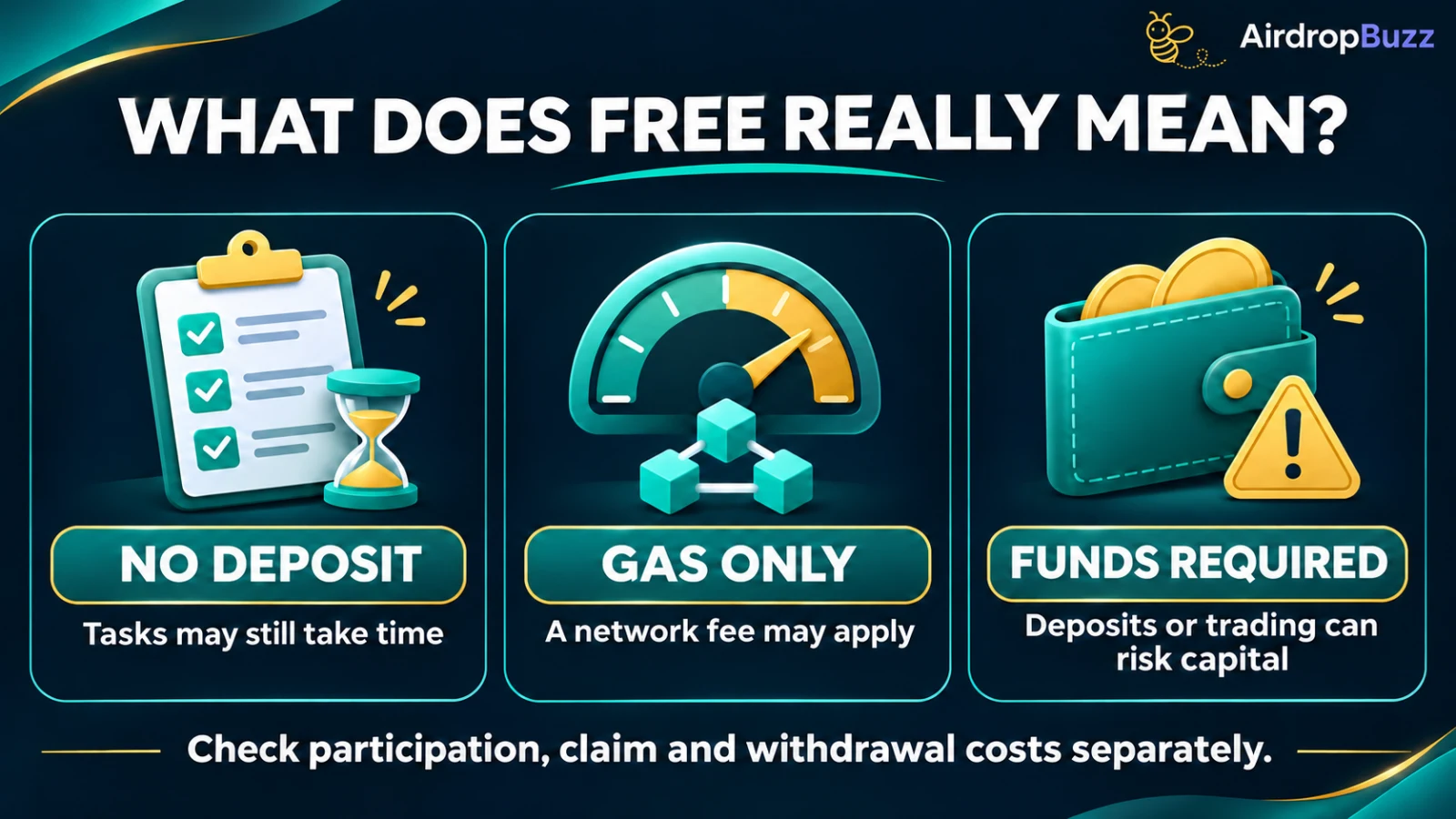
Check three separate stages: joining the programme, claiming a reward and moving or selling it. A free task can lead to a later claim that requires a network fee. A platform may sponsor that fee, but do not assume it will.
| Label | What it can mean | What it does not establish |
|---|---|---|
| No deposit required | The stated entry task does not require funding an account. | No later fees, no privacy cost or a guaranteed reward. |
| Gas only | The relevant on-chain action has no separate mint or purchase price, but a network fee applies. | A zero-cost transaction, safe contract or valuable token. |
| Funds required | The qualifying route involves a deposit, trade, purchase or other funded action. | That funds cannot be lost or that rewards will cover costs. |
On Ethereum, gas pays for computation and transaction processing. The fee depends on the action and network conditions; see Ethereum’s gas documentation for the fee structure. Other networks have their own fee rules.
For routes that avoid an initial deposit, see our no-investment airdrop guide. Keep the difference between a free starting task and a fee-free withdrawal in mind.
How to check and claim an airdrop: six steps
- Find the official rules first. Confirm the project domain through its established website and linked announcements. Avoid treating a search ad, direct message or forwarded claim URL as proof.
- Check who qualifies. Read the snapshot, account rules, age or geographic restrictions where provided, and any identity checks. A claim for past users may offer no route for a new participant.
- Confirm the wallet and network. Use the wallet that qualified, on the stated chain. A matching-looking address or token ticker on another chain does not establish eligibility.
- Check the amount, timing and costs. Separate the allocation from the unlocked amount. Read any claim deadline and fee estimate before proceeding.
- Inspect each wallet request. Understand what a transaction, message or approval permits. If the request is unclear or differs from the instructions, stop rather than sign.
- Check the result independently. For an on-chain claim, inspect its transaction receipt in the correct block explorer. A pending transaction or updated website balance is not the same as a confirmed token transfer.
Some distributions are automatic and have no claim transaction. Others use a custodial account or an app balance. Follow the documented route instead of looking for a claim button that may not exist. The airdrop eligibility checker guide explains address lookups, snapshots and fake checker pages in more detail.
Can you participate in crypto airdrops on a PC?
Often, yes—when the campaign supports a desktop website and a compatible wallet. Other programmes require a mobile app, a particular ecosystem account or both. The device does not replace the eligibility rules.
Ethereum’s wallet guide distinguishes mobile, desktop and browser-extension wallets. Use the project’s supported connection method and download wallet software through its verified official distribution links.
There is no universal “airdrop crypto for PC” installer that unlocks all campaigns. Be cautious when a page asks you to install an unrelated executable, disable protection or import an existing recovery phrase to receive tokens.
Where to find crypto airdrops today
Start with a list that separates recent listings from open participation and open claims. A newly added guide can describe a waitlist or a claim restricted to previous users. A recently edited article can also contain historical information.
On AirdropBuzz, use Latest Airdrops for discovery and the Opportunity Scoreboard to compare editorial assessments. Read each guide’s dated sources, participation costs and campaign notices before acting. A Potential Score is an editorial assessment, not a probability of payment.
Then verify the current rules on the project’s own website. Even a genuine open claim does not mean your wallet qualifies. Treat a label such as “updated” as a reason to inspect what changed, rather than proof of an available reward.
What about the “most profitable” crypto airdrops?
Historical payouts can explain why airdrops attract attention. They cannot establish which campaign will be profitable for a new user. Eligibility changes, snapshots pass and advertised token values may not reflect a price you can actually sell at.
For context, our historical airdrop payout article has a different purpose from a current opportunities list. Do not treat an old payout as an offer still available today.
A simple cost example: suppose a participant actually receives $25 from selling a reward and has paid $8 in total participation, claim and sale costs. The remaining amount is $17 before taxes and the value of their time. If no reward arrives, the $8 is still spent. These are hypothetical amounts, not a campaign forecast.
The AirdropBuzz Team’s practical test is whether you can explain the reward evidence, eligibility and total costs before joining. Do not generate unnecessary trading volume just to chase a points balance with no documented conversion.
How to spot a fake airdrop claim
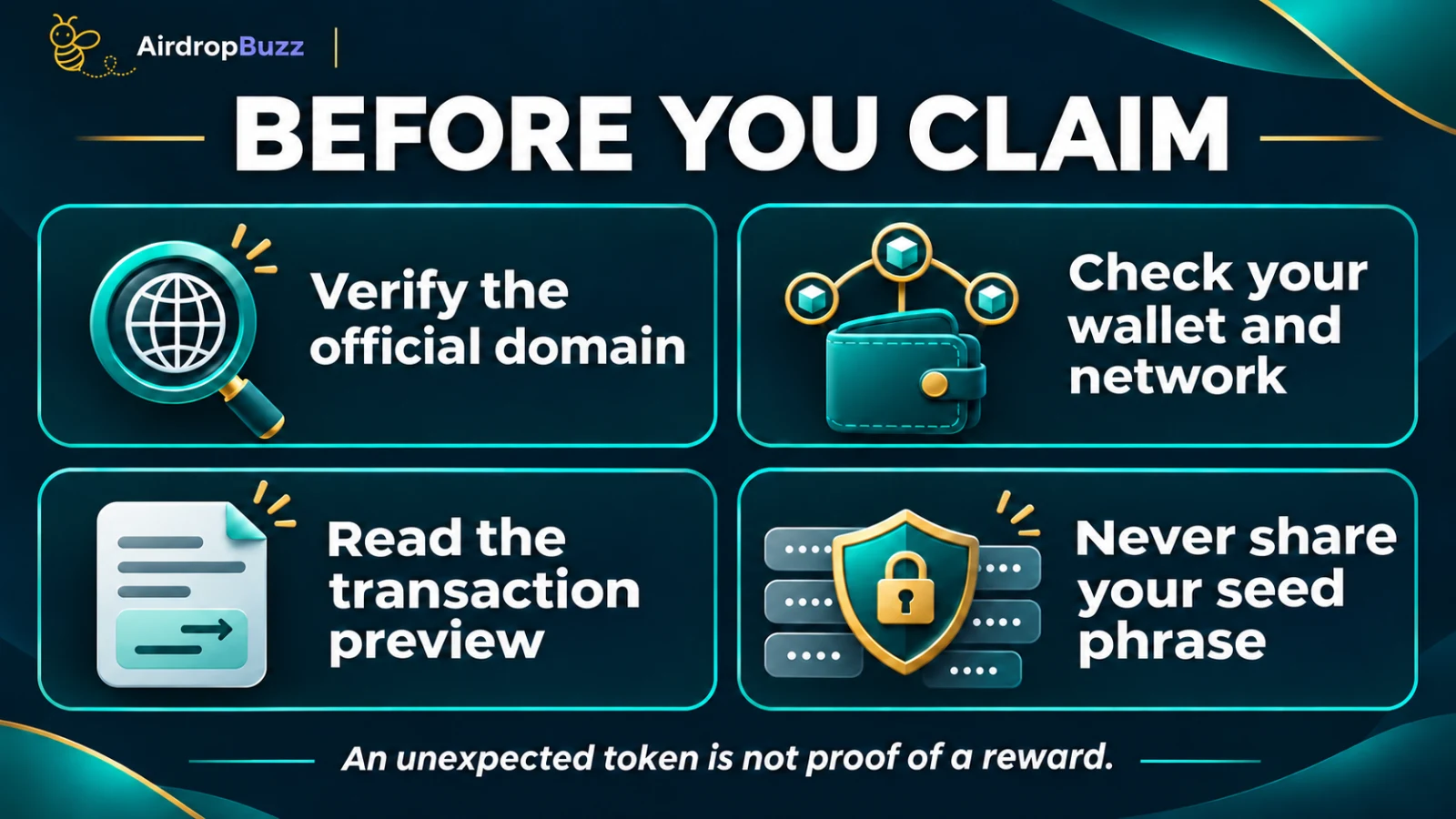
Stop if a purported claim asks for your seed phrase or private key. Be wary of pressure to send a separate “unlock payment” to an unknown address. A legitimate network fee is different from a payment demanded by someone claiming to release a reward.
Ethereum’s security guidance warns about recovery-phrase theft, misleading links and giveaway scams. Coinbase’s wallet safety guidance also recommends checking the actual dapp URL and protecting the recovery phrase.
Read approvals carefully. A token approval can let a contract move a specified token from your wallet. Gas-free messages can also carry authority, so “no gas” does not make every signature harmless.
Disconnecting a wallet is not the same as revoking token approvals. MetaMask explains that existing approvals can remain after disconnection. Review permissions through trusted wallet or explorer tools, and understand any revocation transaction before confirming it.
Where should a beginner start?
Choose one programme whose entry requirements you understand. Write down whether it offers points, an announced allocation or an open claim, and identify the evidence for that description. Then check the full cost and whether you can still qualify.
If those answers are missing, waiting is a reasonable choice. A shorter, well-understood task list is more useful than joining every result labelled “free.”
Compare the latest airdrop guides
Sources and verification
Last source check: November 15, 2026. This educational guide uses the official references below. It does not verify a particular reader’s eligibility or establish that any individual campaign is open.
- Ethereum: security and scam prevention — recovery-phrase protection and claim-site risks.
- Ethereum: gas and fees — network costs and failed transactions.
- Ethereum: wallets — supported wallet formats.
- MetaMask: airdrop phishing scams — unsolicited assets and misleading claim pages.
- MetaMask: token approvals — permissions to move tokens.
- MetaMask: signature phishing — risks from off-chain signature requests.
- MetaMask: wallet disconnection — why disconnection does not revoke approvals.
- Coinbase: avoiding crypto scams — checking dapp URLs and protecting wallet credentials.
Crypto airdrop FAQs
What is a cryptocurrency airdrop in simple terms?
It is a token distribution to users or wallets that meet a project’s rules. It may be automatic or require a claim. A points programme or waitlist alone does not confirm a token reward.
Can I get crypto airdrops without investing money?
Some programmes offer no-deposit tasks. Check whether a later claim, transfer or withdrawal requires fees. Your time and any personal information requested also matter.
Does completing every task guarantee an airdrop?
No. Eligibility, anti-abuse checks, allocation rules and any announced token conversion can affect the outcome. Some programmes offer points or access without committing to tokens.
Can I claim airdrops on a Windows PC?
Yes, if the campaign supports a desktop website and your wallet. Others require a mobile app. There is no universal PC installer for all crypto airdrops.
Are crypto airdrops profitable?
Some past recipients received valuable tokens; others received nothing or spent more than their rewards were worth. Judge actual proceeds after costs, not a displayed token balance or a historical headline.
Should I claim every unexpected token in my wallet?
No. Unsolicited tokens can be part of a phishing attempt. Verify the project independently and avoid following token-embedded links or signing unexplained requests.