TL;DR / Key Takeaways
- Direct Bitcoin mining normally uses specialised SHA-256 ASIC hardware.
- GoMining describes provider-managed mining capacity with ongoing maintenance costs.
- IAMiner’s trial FAQ lists USDT, DOGE and LTC rather than BTC; withdrawals remain unverified.
- IAMiner’s public paid-plan return estimates conflict with its terms.
- Electricity, equipment, fees and withdrawal conditions matter more than a dashboard estimate.
On this page Jump straight to the sections you need Built for mobile reading and quick skimming.
To mine Bitcoin directly, you normally use a SHA-256 ASIC miner, suitable power and cooling, a Bitcoin wallet and a mining pool or solo setup. An app can help manage mining or provide access to a hosted service. Installing an app does not, by itself, turn your phone into a competitive Bitcoin miner.
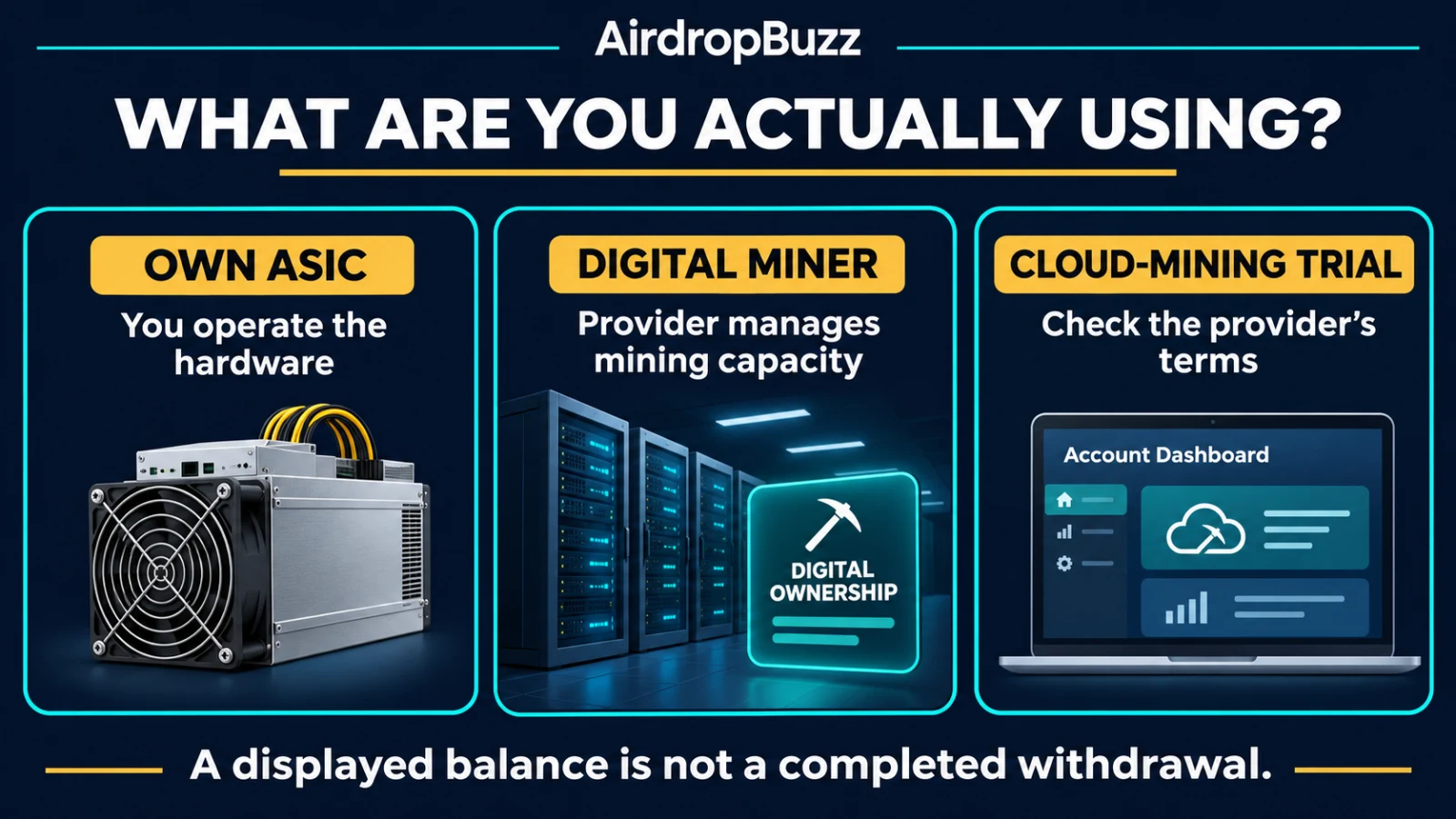
That distinction matters when comparing IAMiner, GoMining and hardware tools. They do not offer the same product, require the same costs or provide the same evidence of rewards. Before choosing a route, ask two questions: where does the mining happen, and what can I actually withdraw?
This guide explains how to mine Bitcoin, compares the main routes and works through an electricity-cost example. It links to AirdropBuzz’s existing IAMiner trial review and GoMining review for deeper product coverage. The comparison is based on public documentation checked on November 15, 2026; no new hardware, purchase or withdrawal test was performed for this article.
Bitcoin mining tools compared: what are you using?
| Route or tool | What it does | Main costs | Important limit |
|---|---|---|---|
| Your ASIC + a pool such as Braiins Pool | You operate physical Bitcoin mining hardware and submit work to the pool. | Equipment, electricity, cooling, maintenance and applicable pool or payout fees. | Pool payments do not guarantee that revenue exceeds your costs. |
| GoMining | The provider describes digital miners representing mining capacity in its infrastructure. | Digital-miner purchase and ongoing electricity/service charges under the selected product. | You rely on the provider and its terms; you are not operating the equipment yourself. |
| IAMiner | A provider-managed cloud-mining trial and optional paid plans. | The trial is advertised at $0; paid plans are separate. | The free-trial FAQ lists USDT, DOGE and LTC—not BTC. Withdrawals and mining operations were not independently verified. |
| CoinWarz Bitcoin mining calculator | Estimates mining economics from inputs such as hash rate, power and electricity price. | Your estimates must include real operating and purchase costs. | A calculator does not mine Bitcoin or promise a payout. |
How does Bitcoin mining work?
Bitcoin miners compete to produce valid proof of work for new blocks. The successful block can earn its miner a block reward and transaction fees. An ASIC is a specialised computing device; Bitcoin mining equipment is designed for the SHA-256 algorithm.
Bitcoin’s developer guide distinguishes solo mining from pooled mining. A solo miner can face long gaps between rewards. A pool combines participants’ work and distributes rewards under its payment rules, reducing the variance of individual payments.
Neither arrangement removes operating costs. Higher hash rate means more computing work, but the result also depends on network competition, uptime, equipment efficiency and the payout method. A larger displayed hash rate alone is not a profit calculation.
How to mine Bitcoin at home: six practical steps
- Check the location before the machine. Confirm the electrical supply, ventilation, noise constraints and applicable local requirements. Follow the manufacturer’s installation requirements and use qualified electrical help where needed.
- Estimate the complete cost. Include equipment, delivery, electricity, extra cooling, repairs, downtime and fees. Use your actual electricity tariff rather than an online example from another country.
- Choose compatible SHA-256 equipment. Check the exact model’s hash rate, wall-power draw, efficiency, condition and warranty. A low purchase price can hide high running costs.
- Set up a Bitcoin payout wallet. Protect its backup and verify the address. Your payout address is not a reason to give a pool or hosting company your seed phrase.
- Configure the miner using the selected pool’s official instructions. Enter the correct server and worker details, and check the payout policy. Use firmware compatible with the exact hardware; downloading random “Bitcoin mining software” is not a substitute for equipment.
- Measure operation and payments. Compare accepted work, rejected shares, actual power use, uptime and wallet receipts. Recalculate when network conditions, fees or electricity prices change.
Braiins Pool’s official setup guide provides a documented example for compatible ASIC miners. Its rewards and payout documentation explains the payment framework. Check the current account rules rather than assuming every pool has identical fees or withdrawal thresholds.
What does Bitcoin mining cost? Start with electricity
One useful calculation needs no Bitcoin price forecast:
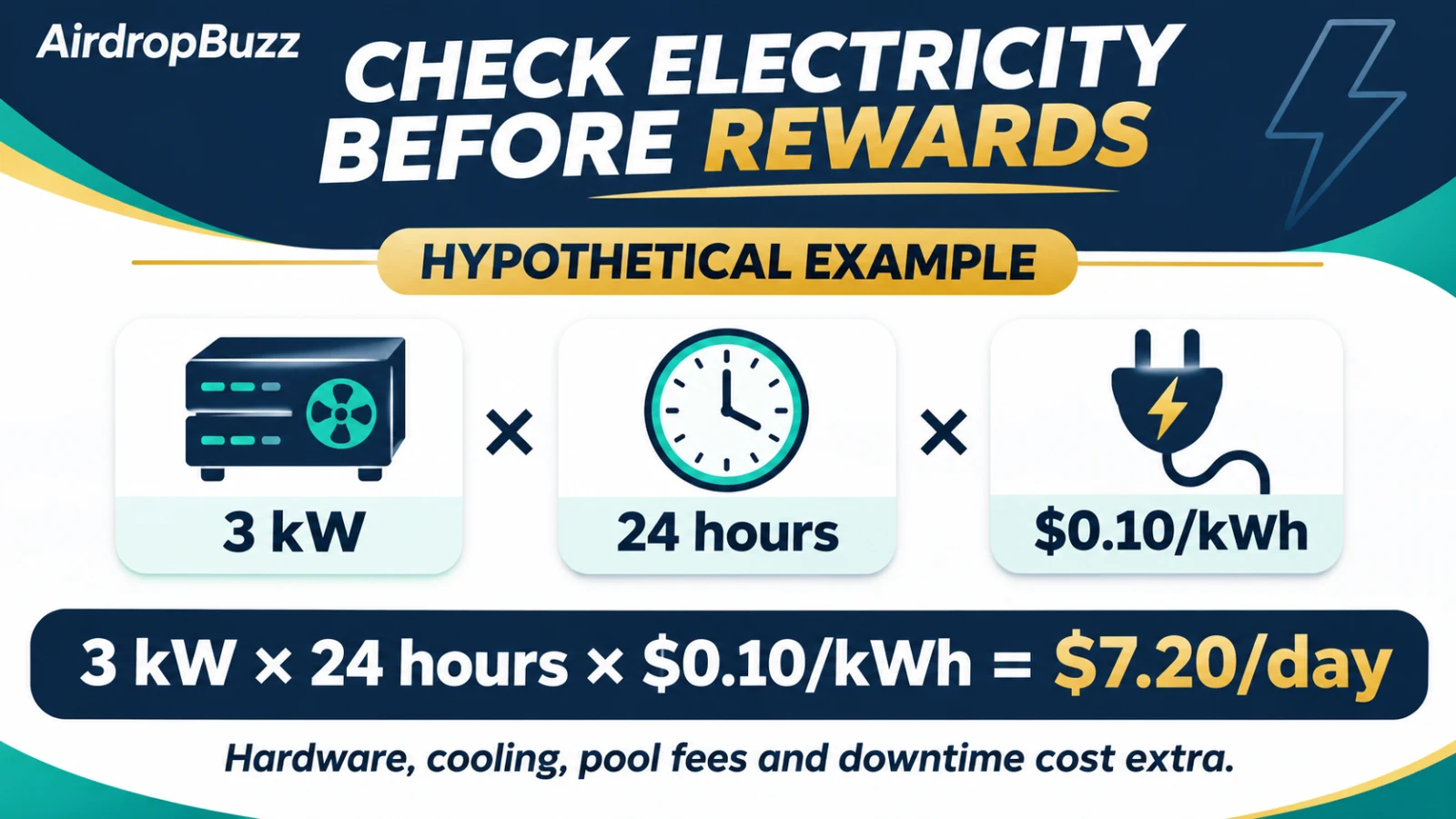
Daily electricity cost = power in kilowatts × operating hours × price per kilowatt-hour.
For a hypothetical machine drawing 3,000 watts, convert that to 3 kilowatts. Running it for 24 hours at $0.10 per kWh costs $7.20 per day, or $216 over 30 days. That is electricity alone—not an estimate of mining income or a quote for a particular miner.
| Electricity price | 24-hour electricity cost | 30-day electricity cost |
|---|---|---|
| $0.05/kWh | $3.60 | $108 |
| $0.10/kWh | $7.20 | $216 |
| $0.20/kWh | $14.40 | $432 |
Then compare projected mining revenue with all costs. CoinWarz’s Bitcoin mining calculator is one tool for exploring inputs. Its results are estimates, not proof that a purchase will pay for itself.
Keep operating profit separate from recovering the equipment price. For example, a hypothetical $1,000 machine producing $2 a day after running costs would take 500 days to recover that price if the margin never changed. In practice the margin can change or turn negative; this arithmetic is not a payback forecast.
GoMining: access to a digital miner, not mining on your phone
GoMining describes its digital miners as NFTs backed by Bitcoin mining equipment. The product has computing-power and energy-efficiency parameters, and the provider describes BTC rewards from its infrastructure. These are the provider’s statements, not an independent inspection of its facilities.
You manage a product through an app or account rather than operating an ASIC at home. This changes the responsibilities and risks: you avoid managing the physical installation but depend on the provider, its accounting and its product terms.
GoMining’s product documentation explains maintenance charges. When comparing a quote, check what is deducted for electricity and service, whether a discount requires holding a separate token, and what happens if rewards fall. Moving a fee into another token does not eliminate the cost or that token’s price risk.
Before purchasing, record the total price, expected fees, withdrawal conditions and any resale restrictions for the exact product. Do not use an old promotional entry price as today’s checkout price. Our GoMining review on AirdropBuzz provides further context; use current official terms for a purchase decision.
IAMiner: what its free mining trial actually says
IAMiner’s current FAQ describes a 30-day Free robot, operating in 48-hour sessions before it needs restarting. It lists trial withdrawal windows on days 3, 10 and 20. Those are advertised conditions; access to a dashboard does not demonstrate that a withdrawal will succeed.
For readers searching for Bitcoin mining, the payout currency is a key distinction. The free-trial answer lists USDT on BNB Smart Chain, Dogecoin and Litecoin. It does not list BTC for that trial. Receiving another asset or a displayed dollar balance is not the same as receiving mined Bitcoin.
There is also a material inconsistency in the public documents checked on November 15. IAMiner’s paid-plan homepage cards advertise monthly estimates of 50%–83.33%. Its terms describe estimated monthly results of 1%–2%. The article cannot reconcile those claims or establish which would govern a particular purchase.
The AirdropBuzz Team does not recommend paying for an upgrade while that conflict remains unresolved. We have not independently established the underlying mining operation or successful trial withdrawals for this comparison. A free signup does not remove platform, privacy or later payment risks.
Read our full IAMiner review for trial conditions and the existing risk assessment. Keep an optional trial separate from any decision to deposit money, buy a paid robot or borrow against crypto. No paid signup is necessary to understand the advertised free offer.
Can you mine Bitcoin on a phone or normal PC?
A phone can run an account interface or help monitor a service. That does not mean its processor supplies the Bitcoin hash rate advertised by the provider. GoMining’s digital-miner model, for example, places the mining equipment in provider infrastructure.
A normal computer can be useful for setup, research and monitoring, but it is generally not a competitive Bitcoin mining machine. Bitcoin.org describes mining as a specialised industry using purpose-built hardware.
Likewise, an app that awards points, shows a simulated balance or pays a different coin is not automatically a Bitcoin miner. Ask the provider to explain the hardware or hash-power arrangement, payout asset and withdrawal conditions. Installing more apps does not resolve missing evidence.
Is free Bitcoin mining a realistic way to earn?
The network’s proof-of-work calculation needs computing resources. A provider can subsidise a limited trial, but “free to activate” does not establish unlimited hash power, a withdrawable BTC balance or profit.
Use three evidence levels: an advertised estimate, a balance visible inside an account and a completed payment to a wallet you control. They answer different questions. A successful small withdrawal, if documented, would establish that one payment—not that future rewards or the operator’s long-term economics are safe.
Do not send a separate payment to an unknown address simply because someone promises to unlock a withdrawal. Check documented minimums, fees, supported networks and identity requirements first. Our crypto safety guide explains the broader warning signs.
Which mining route makes sense for you?
- To learn the protocol: start with Bitcoin’s mining documentation and a cost worksheet before purchasing anything.
- To operate equipment: research an appropriate ASIC, installation conditions and a pool such as Braiins Pool. Confirm the economics for your location.
- To explore a provider-managed product: compare the total purchase cost, fees and withdrawal terms. GoMining’s digital-miner documentation is a starting point for research, not a guarantee.
- To investigate IAMiner: read the free-trial terms and the return conflict first. Its listed trial payout assets should not be presented as a verified Bitcoin payout.
Mining, buying BTC and earning promotional rewards are separate activities. If your goal is simply to understand or hold Bitcoin, there is no requirement to buy a miner or join a cloud service.
Read the IAMiner trial and withdrawal checks
Some linked AirdropBuzz product reviews contain referral links. Check their disclosures. This comparison does not add a direct referral signup link or claim that any platform guarantees earnings.
Sources and verification
Official-source check: November 15, 2026. Provider documents support descriptions of advertised features and terms; they do not independently prove hardware ownership, reserves, safety or payout reliability.
- Bitcoin developer guide: mining — ASIC work and solo versus pooled mining.
- Bitcoin.org: supporting Bitcoin — purpose-built mining hardware.
- Braiins Pool: Bitcoin mining setup and rewards and payouts — pool connection and payment rules.
- CoinWarz: Bitcoin mining calculator — an estimation tool, not a mining service.
- GoMining FAQ and digital-miner documentation — provider-managed capacity and maintenance.
- IAMiner FAQ, homepage and terms — trial conditions, payout assets and conflicting return estimates.
Bitcoin mining FAQs
What do I need to mine Bitcoin?
For a conventional direct-mining setup, research a compatible SHA-256 ASIC, power and cooling, a Bitcoin payout wallet and a pool or solo arrangement. Provider-managed products have different requirements and risks.
Can I mine Bitcoin for free?
A provider may subsidise trial access, but that does not establish a withdrawable BTC reward. Check the asset, fees, limits and payment evidence. Direct hardware mining has operating costs.
Does GoMining mine Bitcoin on my phone?
GoMining describes mining equipment in provider infrastructure. Its app is the interface for managing a digital miner and rewards; your phone is not the physical ASIC performing that work.
Does IAMiner’s free trial pay Bitcoin?
The FAQ checked on November 15, 2026 lists USDT on BNB Smart Chain, Dogecoin and Litecoin for the trial. BTC was not listed in that answer. Successful withdrawals were not independently verified.
Is Braiins Pool a free cloud-mining app?
No. The pool’s conventional Bitcoin mining setup connects compatible mining hardware. Read its current service, fee and payout documentation; creating an account does not provide a free ASIC.
How long does it take to mine one Bitcoin?
There is no fixed answer for every miner. Your computing contribution, network conditions, uptime, pool rules and fees affect results. A calculator projects outcomes from assumptions; it cannot promise a date.