
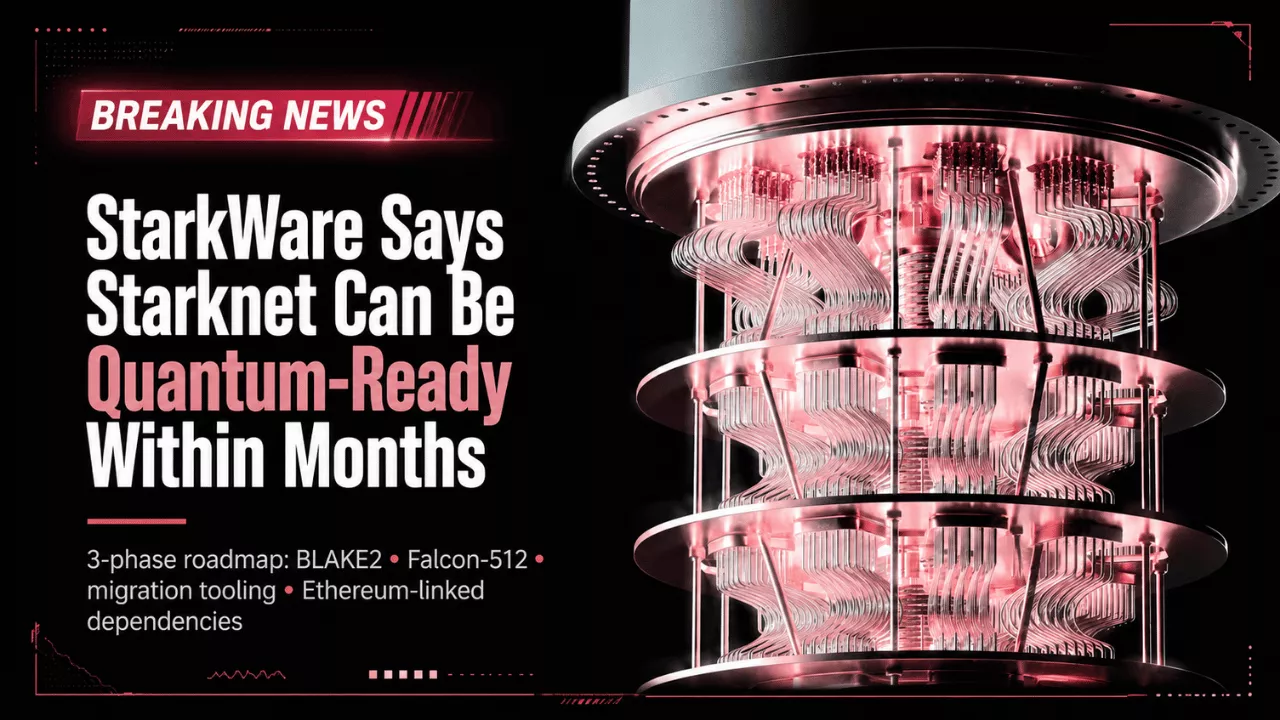


StarkWare has released a three-phase post-quantum roadmap for Starknet, putting quantum-resistance back into the center of the Ethereum scaling conversation. The announcement matters because Starknet is not only another Layer 2 network; it is built around STARK proofs, a zero-knowledge proof system widely discussed for its hash-based security assumptions.
According to The Block, StarkWare described the plan as a three-stage path to make Starknet quantum-ready. The roadmap focuses on removing remaining elliptic-curve dependencies, adding post-quantum signature schemes such as Falcon-512, and preparing migration tools for contracts already live on the network.
What StarkWare Is Trying To Change
The first phase targets core network components. StarkWare plans to move away from Pedersen hashing toward BLAKE2 across areas such as state commitments, contract addresses and network configuration. It also points to post-quantum consensus signatures, including Falcon-512, as part of the early technical direction.
The second phase focuses on migration tooling. That is important because a blockchain cannot become quantum-ready only by upgrading new contracts; existing contracts, wallets and developer flows also need a practical path forward. For builders, this is the part to watch closely because migration complexity often decides how quickly a security roadmap becomes real infrastructure.
The third phase looks beyond Starknet itself. Some dependencies still connect back to Ethereum, including bridge-related functionality and blob data availability. In simple terms, Starknet can harden its own stack, but the full security picture still depends partly on how Ethereum handles its own post-quantum transition.
Why This Matters For Crypto Users
For most users, quantum computing still feels far away. But crypto is long-lived infrastructure: wallets, bridge contracts, rollups and archived data may remain valuable for years. That is why post-quantum planning is becoming more than an academic topic. Financial-sector groups, including the G7 Cyber Expert Group, have also warned that institutions should prepare coordinated post-quantum migration plans before the risk becomes urgent.
For Starknet users, the immediate takeaway is not that wallets need to panic today. The better read is that StarkWare is trying to turn Starknet's STARK-based design into a broader end-to-end security roadmap. StarkWare's earlier technical writing has argued that STARK proofs rely on hash-based assumptions rather than elliptic-curve pairings, but also noted that network and wallet dependencies still need work before a full post-quantum claim is complete.
Airdrop And Ecosystem Angle
For airdrop hunters and ecosystem users, this roadmap could influence where developer attention moves next. Security upgrades, migration tooling, wallet improvements and developer test programs often create new tasks, grants, bug bounties or ecosystem campaigns. None of that guarantees an airdrop, but it does make Starknet worth watching for technical quests and infrastructure-focused participation.
The safest approach is to follow official StarkWare and Starknet channels, avoid fake migration or claim links, and treat any sudden "quantum upgrade airdrop" page with caution. Roadmap news often attracts phishing attempts, especially when users expect new tasks or wallet actions.
What To Watch Next
- Concrete timelines for BLAKE2-related network changes.
- Developer documentation for contract migration tooling.
- Wallet guidance around post-quantum signatures and account abstraction.
- How Ethereum's own post-quantum planning affects L2 bridges and data availability.
- Whether Starknet ecosystem campaigns appear around testing or migration readiness.
No comments yet. Be the first reader to add useful context.