TL;DR / Key Takeaways
- Airdrop hunting in 2026 is about filtering quality opportunities, not joining every campaign.
- The best way to find new airdrops is to combine curated guides, tokenless protocol trackers, quest platforms, and official project channels.
- Always verify official links before connecting your wallet or signing any transaction.
- Use a 100-point scoring framework to judge product strength, airdrop probability, eligibility quality, cost, safety, and community signals.
- Real product usage usually matters more than one-time tasks or lazy farming.
- Points, quests, testnets, and “season” campaigns can be useful signals, but they do not guarantee a token.
- Use a separate low-balance wallet for airdrop hunting and keep your main assets away from experimental dapps.
- Track every campaign in a spreadsheet, including wallet used, actions completed, dates, gas spent, and reward status.
- Avoid Sybil-style behavior such as repeating identical transactions across many wallets.
- The smartest airdrop hunters win by staying early, organized, skeptical, and secure.
On this page Jump straight to the sections you need Built for mobile reading and quick skimming.
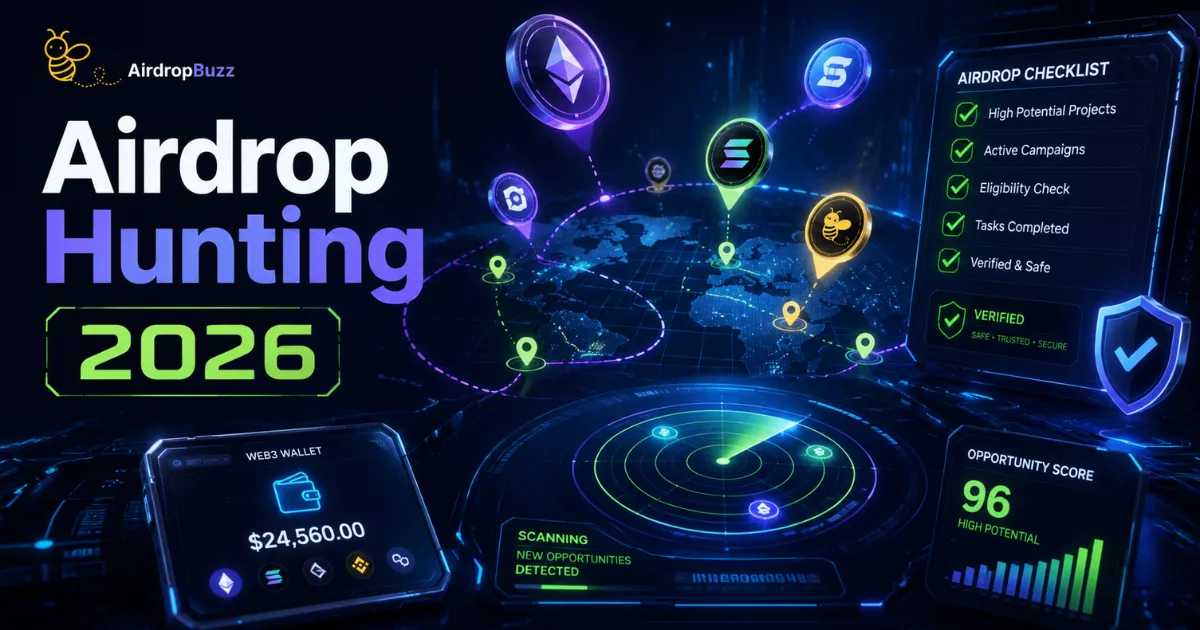
Airdrop hunting in 2026 is no longer just about clicking “claim” before everyone else. The best opportunities now reward users who find strong projects early, complete real actions, avoid Sybil behavior, and protect their wallets like professionals.
This guide gives you a practical framework for finding new airdrops, scoring them, tracking your activity, and staying safe. It is built for users who want a repeatable system, not random Telegram tips.
Important: Airdrops are never guaranteed. A project may run points, quests, testnets, or campaigns without ever launching a token. This guide is educational only and is not financial advice.
What Is Airdrop Hunting?
Airdrop hunting is the process of finding projects that may reward early users with tokens, points, NFTs, stablecoins, or other benefits. A crypto airdrop usually distributes tokens to selected wallets to increase awareness, reward early users, or bootstrap community growth, according to Coinbase’s explainer on what a crypto airdrop is.
In earlier cycles, many hunters focused on simple actions: bridge once, swap once, join Discord, and wait. In 2026, that approach is weak. Projects now look for deeper signals, such as real product usage, repeated activity, governance participation, liquidity behavior, quest completion, wallet history, and Sybil resistance.
How to Find New Airdrops in 2026
The best hunters do not rely on one source. They build a discovery stack. Use these channels together, then verify every opportunity before connecting a wallet.
1. Follow curated airdrop trackers
Start with trusted airdrop pages that update often. On AirdropBuzz, recent examples include Teneo Hub Season 3, AlloX, KieDex, Polymarket, and MetaMask Rewards.
Curated guides are useful because they save time. But you should still verify official links, campaign dates, reward terms, and claim pages before taking action.
2. Track tokenless protocols
Many airdrop hunters watch projects that have product usage but no token yet. DeFiLlama has an airdrops page that tracks tokenless DeFi protocols across categories like lending, DEXs, derivatives, and other on-chain sectors.
This does not mean every tokenless protocol will launch an airdrop. It means the project has a profile worth researching. Your job is to ask: does it have users, revenue, TVL, funding, ecosystem support, or a clear reason to decentralize?
3. Use airdrop dashboards for task discovery
CryptoRank’s Potential Airdrops Dashboard tracks testnets, social activities, node tasks, staking opportunities, and other reward campaigns. These tools are useful for building a watchlist, especially when you want to compare dozens of campaigns quickly.
Do not treat dashboard listings as guarantees. Treat them as leads. A lead becomes actionable only after you verify the project’s website, official X account, docs, smart contract links, and campaign rules.
4. Watch quest platforms
Quest platforms remain important in 2026 because many Web3 projects use them to verify social and on-chain activity. Galxe says its Quest product helps projects run reward-based loyalty programs, and its docs describe task discovery, eligibility checks, reward tracking, and loyalty points through Galxe Quest.
Guild is also useful because projects use it to manage communities through requirements, roles, and rewards. Its documentation explains that Guild tracks on-chain and social activity and can connect communities across Discord, Telegram, X, GitHub, and EVM chains through Guild roles and rewards.
5. Track exchange airdrop programs
Some airdrops now happen through major exchange programs. Binance Megadrop combines Binance Simple Earn, Binance Wallet, and Web3 quests to give users early access to selected projects before listing, based on Binance’s Megadrop FAQ.
Binance HODLer Airdrops work differently. Binance says eligible users can receive tokens based on BNB subscribed to Simple Earn or On-Chain Yields during snapshot periods, according to its HODLer Airdrops FAQ.
These are not the same as self-custody airdrops. They may require exchange accounts, regional eligibility, KYC, and product-specific rules. Always read the announcement before participating.
The 100-Point Airdrop Scoring Framework
Before spending gas, time, or attention, score each opportunity out of 100. This helps you avoid weak campaigns and focus on projects with better risk-reward.
1. Product strength: 20 points
Ask whether the project has a real product. A strong candidate has working apps, active contracts, public docs, growing usage, and clear utility. A weak candidate has only a landing page, vague promises, and referral hype.
- Working app or testnet: 5 points
- Clear use case: 5 points
- Visible user activity: 5 points
- Public docs or roadmap: 5 points
2. Airdrop probability: 15 points
Look for signals, not rumors. Points systems, “season” language, quests, early access campaigns, snapshots, and loyalty programs can suggest future rewards. But unless the team confirms a token or airdrop, treat it as speculative.
- Official points or campaign system: 5 points
- Token not yet launched: 4 points
- Clear reward language: 3 points
- Ecosystem precedent: 3 points
3. Eligibility quality: 15 points
Good airdrops often reward meaningful usage. Arbitrum’s official distribution used multiple eligibility actions and point-based criteria, listed in the ARB airdrop eligibility docs. Starknet’s Provisions Program also rewarded several contributor and user groups, according to the Starknet Foundation. ZKsync’s ZK airdrop included users and contributors, with criteria published by ZK Nation.
The lesson is simple: real usage matters more than lazy farming.
- Repeated product activity: 5 points
- Activity across time, not one day: 4 points
- Different useful actions: 3 points
- Contribution beyond wallet clicks: 3 points
4. Cost control: 15 points
A good airdrop strategy controls cost. You should know your gas spend, bridge fees, swap slippage, subscription cost, and opportunity cost before you start.
- Low gas or testnet access: 5 points
- Tasks can be completed safely: 4 points
- No forced high deposit: 3 points
- Clear exit path: 3 points
5. Safety: 20 points
Safety deserves the highest weight. MetaMask warns users to watch for fake airdrops, phishing, rug pulls, and malicious claim pages in its guide on airdrop scams. Revoke.cash also explains that token approvals can let dapps spend tokens unless permissions are revoked, which is why approval hygiene matters when testing new protocols through approval management tools.
- Official links verified: 5 points
- No seed phrase request: 5 points
- No suspicious unlimited approvals: 4 points
- Known team, audit, or strong reputation: 3 points
- Can use a low-balance wallet: 3 points
6. Community and ecosystem quality: 15 points
Strong projects usually have active builders, clear communication, real users, and ecosystem partners. Weak projects lean on vague “huge airdrop soon” language, fake urgency, bot comments, and endless referral loops.
- Active official X and Discord: 4 points
- Real product discussion: 4 points
- Known ecosystem partners: 3 points
- Transparent updates: 2 points
- No obvious bot engagement: 2 points
Score Bands: What to Do Next
80–100 points: High-priority watchlist. Complete safe tasks, track activity, and check updates weekly.
60–79 points: Worth testing with a low-cost wallet. Avoid large deposits until reward rules are clearer.
40–59 points: Monitor only. Do not spend serious time or gas unless new information improves the score.
Below 40 points: Skip. Your time is better spent elsewhere.
A Weekly Airdrop Hunting Workflow
Use this simple weekly process to stay organized.
Step 1: Build a fresh watchlist
Check new AirdropBuzz guides, tokenless protocols, quest platforms, and exchange announcements. Add only projects that pass your first safety check.
Step 2: Verify official sources
Open the project’s official website, X account, docs, Discord, GitHub, and app. Check whether the campaign link appears on official channels. Never trust a random claim link from replies, DMs, Telegram forwards, or paid comments.
Step 3: Score each project
Use the 100-point framework. Prioritize projects above 60. Skip low-score campaigns even if they look viral.
Step 4: Use the product naturally
Do not spam identical transactions. Real usage looks like a real user: bridge when needed, swap when needed, provide liquidity only if you understand the risk, vote if governance exists, complete quests that match your profile, and return over time.
Step 5: Track everything
Keep a simple spreadsheet with project name, wallet used, chain, actions completed, dates, gas spent, links, points earned, and claim status. This prevents duplicate work and helps you decide whether an airdrop is still worth your time.
How to Avoid Sybil Mistakes
Sybil farming means creating many fake or linked wallets to game a campaign. It is risky because projects can filter suspicious activity. Instead of trying to fake scale, focus on clean wallet history and meaningful usage.
Avoid these patterns:
- Funding many wallets from one address in the same pattern
- Repeating identical transactions across wallets
- Doing all activity in one short time window
- Only interacting when a task appears
- Using bridges, swaps, and contracts with no real purpose
A stronger approach is to use fewer wallets, keep activity natural, and focus on projects you would actually use.
Wallet Safety Rules for Airdrop Hunters
Airdrop hunting exposes you to more links, contracts, bridges, and signatures than normal crypto use. That makes wallet hygiene essential.
- Use a separate wallet for airdrop hunting.
- Keep your main holdings away from farming wallets.
- Never share your seed phrase or private key.
- Bookmark official websites.
- Check URLs carefully before connecting.
- Do not sign messages you do not understand.
- Review token approvals after using new dapps.
- Ignore surprise tokens that ask you to visit a claim site.
- Be extra careful with “urgent” airdrop deadlines from unofficial accounts.
Best Airdrop Categories to Watch in 2026
1. Tokenless DeFi protocols
Look for lending apps, perps DEXs, bridges, restaking tools, stablecoin protocols, and yield platforms with real volume but no token yet.
2. L2 and appchain ecosystems
New chains often need users, liquidity, developers, and community activity. Bridges, swaps, testnet apps, NFTs, governance, and quests can all become useful signals.
3. AI and DePIN networks
AI agents, data networks, bandwidth networks, and device-based apps often use points or task systems. Be strict with privacy and permissions here.
4. Wallet and identity projects
Wallet usage, swaps, referrals, identity badges, and app integrations can matter. For example, users tracking wallet-related opportunities can review guides like the MetaMask Rewards Airdrop Guide.
5. Prediction markets and social apps
These projects may reward trading, market creation, social actions, referrals, or early app usage. Airdrop hunters following this category can study the Polymarket Airdrop Guide as a practical example.
Airdrop Hunting Checklist
Before joining any campaign, ask these questions:
- Is the project real?
- Is the campaign linked from official sources?
- Is there a working app or testnet?
- What actions are required?
- How much will gas and fees cost?
- Is there a confirmed token or only speculation?
- Does the task require risky approvals?
- Can I use a separate low-balance wallet?
- Is there a deadline or snapshot?
- Are rewards capped, random, points-based, or guaranteed?
If you cannot answer most of these, do not rush. Wait for clearer information.
Internal AirdropBuzz Paths to Explore
To apply this framework, you can compare different airdrop types on AirdropBuzz:
- Teneo Hub Season 3 for season-based reward tracking.
- AlloX Airdrop Guide for points and task evaluation.
- KieDex Airdrop Guide for testnet trading activity.
- AirdropBuzz Airdrop Guide for daily Buzz points.
- Base App Passive Income for lower-risk reward research.
Final Verdict: The Smart Airdrop Hunter Wins by Filtering
The biggest edge in 2026 is not doing every airdrop. It is filtering faster than everyone else.
Good hunters find new airdrops early, verify official links, score the opportunity, control cost, use products naturally, and protect their wallets. Bad hunters chase every “free token” headline until they waste gas or sign something dangerous.
Use the framework above every week. Build a clean watchlist. Take notes. Stay skeptical. The best airdrops usually reward patience, real activity, and good security habits.
Editorial Citations
- Coinbase: What is a crypto airdrop?
- DeFiLlama: Airdrops / tokenless protocols
- CryptoRank: Potential Airdrops Dashboard
- Galxe Docs: What is Galxe Quest?
- Guild Docs: What is Guild?
- Binance FAQ: What is Binance Megadrop?
- Binance FAQ: HODLer Airdrops
- Arbitrum Foundation: ARB airdrop eligibility
- Starknet Foundation: Provisions Program
- ZK Nation Docs: ZK airdrop
- MetaMask Help Center: Airdrop scams
- Revoke.cash: Token approval safety
FAQs: Airdrop Hunting Guide 2026
What is airdrop hunting?
Airdrop hunting is the process of finding crypto projects that may reward early users with tokens, points, NFTs, stablecoins, or other benefits. Hunters usually complete product actions, quests, testnets, governance tasks, or social tasks to improve eligibility.
How do I find new airdrops?
You can find new airdrops by checking curated airdrop sites like AirdropBuzz, tracking tokenless protocols, watching quest platforms such as Galxe and Guild, following official project channels, and monitoring exchange airdrop programs.
Are crypto airdrops guaranteed?
No. Many projects run points, quests, testnets, or early access campaigns without guaranteeing a token or airdrop. Treat every unconfirmed airdrop as speculative until the team publishes official details.
What is the safest way to hunt airdrops?
Use a separate low-balance wallet, verify official links, avoid seed phrase requests, review token approvals, and never connect your main wallet to unknown claim pages.
What makes an airdrop worth farming?
A strong airdrop candidate usually has a real product, active users, clear tasks, low participation cost, strong security signals, and official reward or points language. Use a scoring framework before spending time or gas.
What is Sybil farming?
Sybil farming means using many fake or linked wallets to game a campaign. Projects may filter suspicious wallets, especially when activity patterns look copied, automated, or unnatural.
Should I use my main wallet for airdrops?
No. Airdrop hunters should use a separate wallet. Your main wallet should hold long-term assets and should not be exposed to unknown dapps, claim pages, or experimental contracts.
Can I make money from airdrops in 2026?
Some users may earn rewards from airdrops, but returns are not guaranteed. Gas fees, time spent, failed campaigns, scams, and token price drops can reduce or erase profits.