TL;DR / Key Takeaways
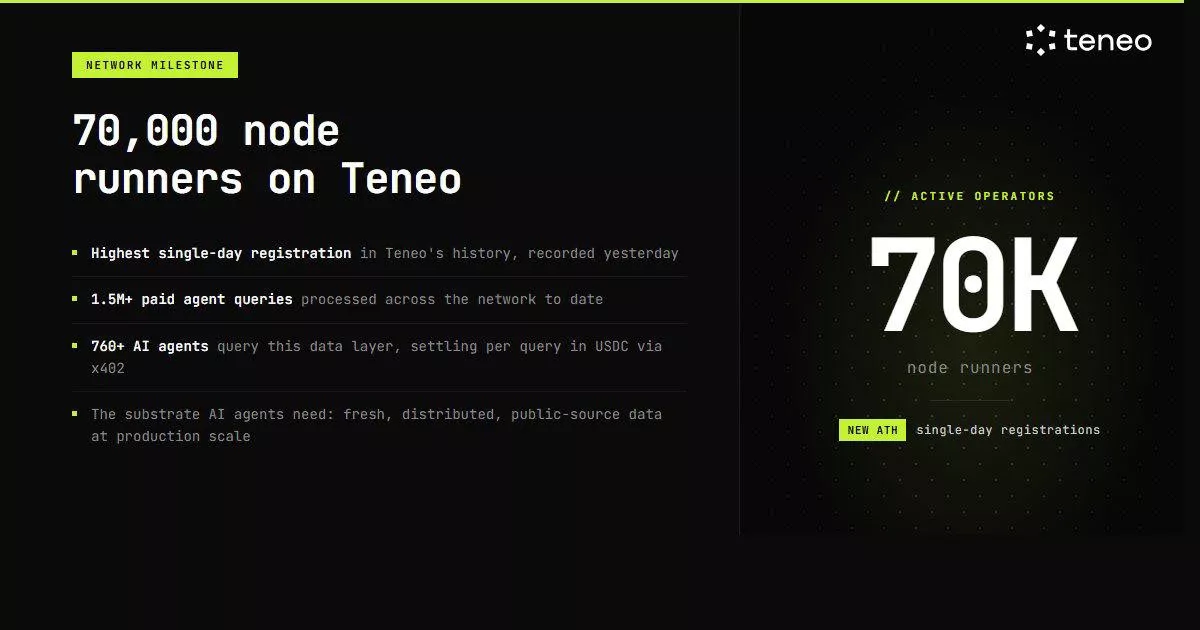
- Teneo Beacon has reached 70,000 node runners, marking a major network milestone.
- The project recorded its highest single-day registration ever.
- Teneo’s data layer supports 760+ AI agents with fresh, distributed public-source data.
- The network has processed over 1.5 million paid AI agent queries via x402.
- Teneo aims to remove API keys, rate limits, and centralized gatekeepers from AI data access.
- The milestone shows rising demand for decentralized AI data infrastructure.
- Users can still join through Teneo Hub or the Teneo Protocol dashboard, but rewards or airdrops are not guaranteed unless officially confirmed.
On this page Jump straight to the sections you need Built for mobile reading and quick skimming.
Teneo Beacon has reached 70,000 node runners, marking a major growth milestone for the decentralized AI data network. The project said it also recorded its highest single-day registration count ever, a sign that interest in community-powered data infrastructure is rising fast.
The update was shared by Teneo Protocol, which said its global operator network now supports more than 760 AI agents and has processed over 1.5 million paid agent queries through x402. Teneo framed the milestone around a simple idea: AI agents are only as strong as the data they can access.
Why the 70,000 Node Runner Milestone Matters
Most AI systems depend on data that can become stale, centralized, or locked behind paywalls. That creates a problem for AI agents that need fresh public information to make decisions, answer questions, or complete tasks in real time.
Teneo is taking a different path. Its network is built around distributed node operators who help feed public-source data into a broader AI data layer. According to Teneo’s documentation, the protocol is a decentralized and permissionless network of autonomous AI agents that turns real-time public data streams into structured intelligence.
That is why 70,000 node runners is more than just a user growth number. It points to a larger shift in the AI and crypto market: data access is becoming infrastructure.
Teneo’s Data Layer Targets a Big AI Problem
AI agents need reliable data to work well. But much of the web is fragmented. Some data sits behind APIs. Some platforms use rate limits. Others require accounts, keys, or permission from a central provider.
Teneo’s message is clear: no API keys, no rate limits, and no gatekeeper deciding what AI can see. Instead, its Beacon network uses a worldwide base of operators to support AI agents with decentralized public data access.
The project’s official website says Teneo decentralizes data ownership and rewards individuals for the value they create through community nodes. This model turns users from passive consumers into active contributors inside the agent economy.
What Role Does x402 Play?
One of the most important parts of Teneo’s update is its use of x402. Teneo said its network has already processed more than 1.5 million paid queries through x402, showing real payment activity between agents and data services.
x402 is an open payment protocol developed by Coinbase that enables instant, automatic stablecoin payments directly over HTTP. In simple terms, it lets software, APIs, and AI agents pay for access without using traditional accounts, card forms, or long sign-up flows.
For AI agents, this is important. An agent can request data, pay for it, and keep working without waiting for a human to approve every step. That could make x402 a key payment layer for machine-to-machine commerce.
Teneo Beacon Growth Shows Demand for Decentralized AI Infrastructure
The jump to 70,000 node runners comes at a time when crypto and AI projects are racing to build the rails for autonomous agents. These agents need three things: data, payments, and execution.
Teneo is positioning itself at the center of that stack. Beacon nodes help collect and route data. AI agents use that data to answer queries or perform tasks. x402 allows paid access and settlement.
This creates a feedback loop. More node runners can help improve network coverage. Better coverage can attract more agents. More agent activity can increase demand for paid queries. That is the growth story Teneo is trying to build.
Can Users Still Join Teneo?
Yes. Users who want to explore the ecosystem can join through Teneo Hub or the Teneo Protocol dashboard. These links include referral codes:
As always, users should review the official rules, device requirements, reward details, and privacy terms before running any node software. Teneo has not confirmed that participation guarantees any token allocation unless stated through official project channels.
Final Take
Teneo Beacon reaching 70,000 node runners is a strong signal for the project’s growth. It also reflects a wider market trend: AI agents need fresh, open, and machine-readable data at scale.
If Teneo can keep growing its operator network while driving real paid query demand through x402, it could become one of the more closely watched AI data infrastructure projects in Web3.
FAQs
What is Teneo Beacon?
Teneo Beacon is part of Teneo Protocol’s decentralized data network. It allows users to run nodes that help support AI agents with public-source data.
How many Teneo Beacon node runners are there?
Teneo Protocol said Teneo Beacon has reached 70,000 node runners, with its highest single-day registration recorded during the latest milestone update.
What are Teneo nodes used for?
Teneo nodes help power a decentralized data layer for AI agents. The goal is to turn real-time public data into useful, structured intelligence for agent-based applications.
What is x402 in Teneo?
x402 is a payment protocol that lets AI agents and online services make instant stablecoin payments over HTTP. Teneo uses x402 for paid agent queries across its network.
Does joining Teneo guarantee an airdrop?
No. Users should not assume that joining Teneo guarantees an airdrop or token reward unless Teneo confirms it through official channels.
Where can users join Teneo?
Users can join through Teneo Hub or the Teneo Protocol dashboard.